
Stop Publishing More Content – “Publish consistently.”
It is one of the most repeated pieces of marketing advice.
So businesses create a calendar, choose a few keywords, and start producing.
Two blogs this week. Three next week. Another ten next month.
Soon, the website has 100 articles.
But when someone finally looks at the numbers, only a handful are generating meaningful traffic, enquiries, backlinks, or visibility.
The rest are simply there.
This is where publishing more content stops being a strategy and starts becoming a habit.
Content marketing does need consistency. But consistency should never mean producing something simply because Tuesday is your publishing day.
Sometimes the smartest thing you can do is stop creating new content for a moment and make the content you already have considerably better.
1. More Content Doesn’t Automatically Mean More Visibility
There is an understandable logic behind publishing frequently.
More pages create more opportunities to rank.
More topics create more ways to be discovered.
And when the strategy is good, that can absolutely work.
The problem begins when volume becomes the objective.
A business publishes 20 loosely connected articles instead of creating five genuinely useful resources around subjects its customers care about.
The website gets bigger.
Its authority doesn’t necessarily get stronger.
Search visibility comes from relevance, usefulness, structure, authority, and how well your content satisfies what people are actually looking for.
Page count alone doesn’t create that.
Key Insight: A bigger content library isn’t automatically a stronger one.
2. Your Existing Content May Be Competing With Itself
Imagine you already have these articles:
“SEO Tips for Small Businesses”
“Best SEO Strategies for Small Businesses”
“Small Business SEO Guide”
“How Small Businesses Can Improve SEO”
Then somebody suggests:
“10 SEO Ideas for Small Businesses.”
It feels like another relevant topic.
But do you really need five pages?
When several articles target almost the same search intent, they can create unnecessary overlap.
Instead of building one authoritative resource, you’ve divided your knowledge across multiple similar pages.
Before adding another article, ask whether the topic already exists somewhere on the website.
Sometimes the best new piece of content is not new at all.
It is two or three average pages combined into one excellent resource.
Key Insight: Before creating another page, check whether you’re strengthening your website or duplicating it.
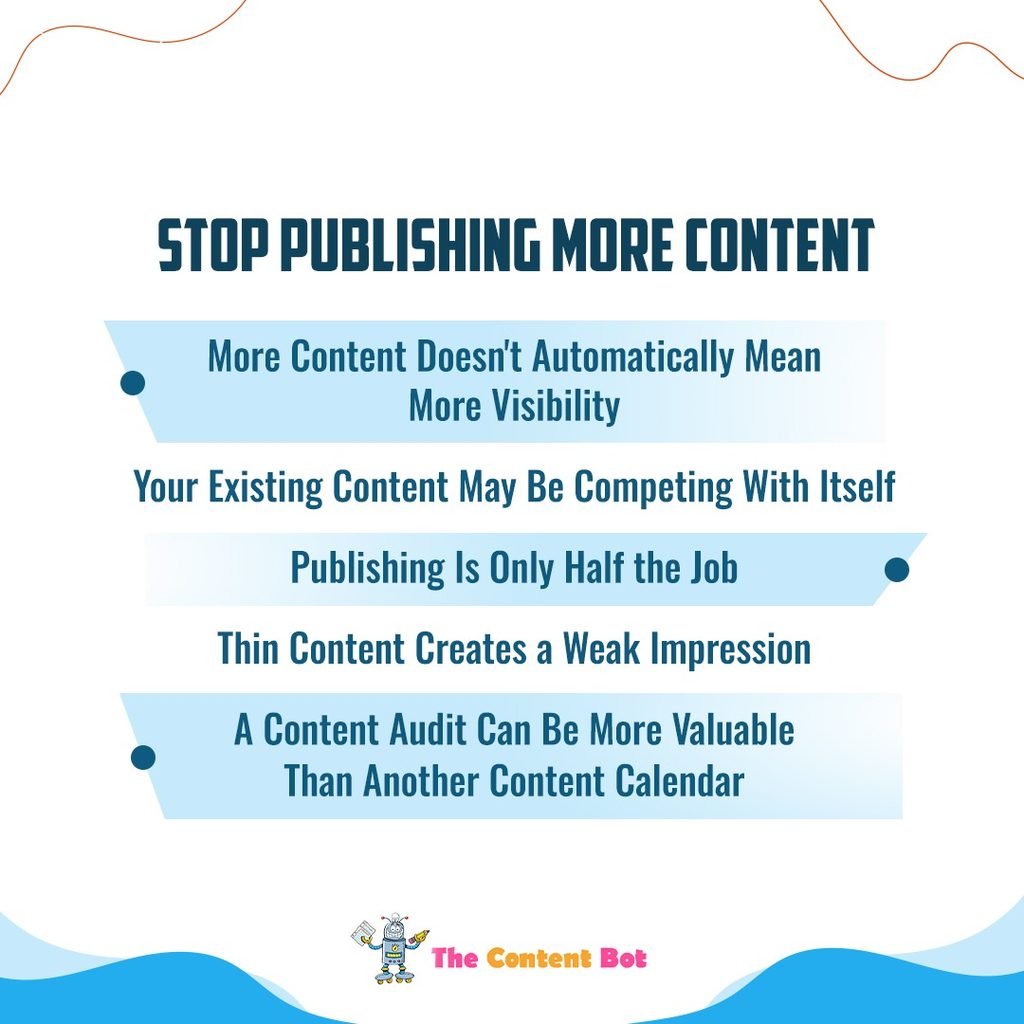
3. Publishing Is Only Half the Job
Businesses often put enormous effort into getting an article live.
Research, Writing, Editing, Design, SEO.
Upload.
Publish.
Then everyone moves on.
But a good piece of content should have a life after publication.
It can be updated as the industry changes.
Its strongest ideas can become social posts.
Sections can support sales conversations.
It can link to related resources.
New articles can link back to it.
It can become a video, newsletter, presentation, or guide.
Its performance can be reviewed and improved.
If your organisation publishes content but rarely returns to it, you’re probably leaving a significant amount of value unused.
Key Insight: Publishing content is the beginning of its useful life, not the end.
4. Thin Content Creates a Weak Impression
Not every article needs to be 3,000 words.
In fact, forcing unnecessary length can make content worse.
But every page should have a reason to exist.
If an article merely repeats the same generic advice found across hundreds of other websites, what does it contribute?
- Why should somebody read it?
- Why should another website reference it?
- Why should a search engine prioritise it?
- Why should an AI system consider it useful when generating an answer?
Strong content usually contains something more.
Experience.
Clear explanations.
Original perspectives.
Useful examples.
Specific expertise.
Better organisation.
Practical answers.
The goal isn’t to make every article longer.
It’s to make it worth finding.
Key Insight: Content needs a reason to exist beyond targeting a keyword.
5. A Content Audit Can Be More Valuable Than Another Content Calendar
Before planning your next 30 articles, look at the last 100.
- Which pages receive impressions?
- Which rank close to page one?
- Which attract links?
- Which support conversions?
- Which are outdated?
- Which overlap?
- Which receive virtually no visibility?
- Which still represent your current services and positioning?
This exercise usually reveals opportunities that a fresh content calendar would completely miss.
Some pages need updating, stronger internal links, should be combined.
Some may need to be repositioned.
Others might no longer deserve a place on the website.
Once you understand what you already have, deciding what to publish next becomes much easier.
Key Insight: The best content strategy begins with knowing what your existing content is actually doing.
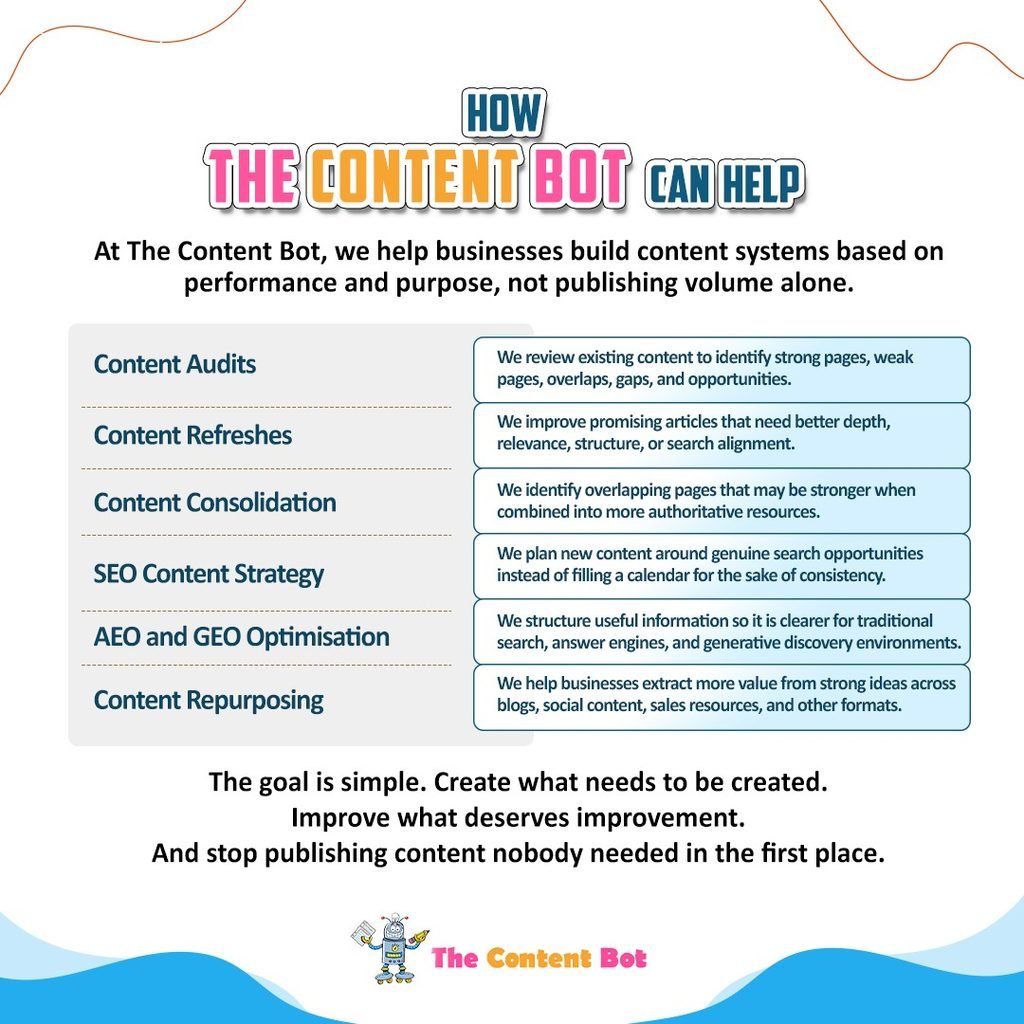
How The Content Bot Can Help
At The Content Bot, we help businesses build content systems based on performance and purpose, not publishing volume alone.
Content Audits
We review existing content to identify strong pages, weak pages, overlaps, gaps, and opportunities.
Content Refreshes
We improve promising articles that need better depth, relevance, structure, or search alignment.
Content Consolidation
We identify overlapping pages that may be stronger when combined into more authoritative resources.
SEO Content Strategy
We plan new content around genuine search opportunities instead of filling a calendar for the sake of consistency.
AEO and GEO Optimisation
We structure useful information so it is clearer for traditional search, answer engines, and generative discovery environments.
Content Repurposing
We help businesses extract more value from strong ideas across blogs, social content, sales resources, and other formats.
The goal is simple.
Create what needs to be created.
Improve what deserves improvement.
And stop publishing content nobody needed in the first place.
Frequently Asked Questions
Should businesses publish fewer blogs? Not necessarily. The right publishing frequency depends on your market, resources, goals, and existing content. Quality and strategic relevance matter more than hitting an arbitrary number.
Is frequent publishing good for SEO? Frequent publishing can help when the content addresses genuine opportunities. Publishing weak or repetitive articles simply to maintain frequency is unlikely to be a strong long-term strategy.
What is content cannibalisation? It generally refers to situations where multiple pages target very similar queries or search intent and compete or overlap unnecessarily.
How often should a content audit be conducted? That depends on how large and active your website is. Websites publishing frequently usually benefit from reviewing performance periodically rather than waiting years.
Should old blogs be deleted? Not simply because they’re old. First determine whether they should be updated, consolidated, redirected, retained, or removed based on their value and relevance.
How do I decide what to publish next? Look at customer questions, search demand, buyer intent, existing content gaps, business priorities, and topics where your organization has genuine expertise.
Here’s How This Helps
SaaS Company Consolidates Similar Articles
A SaaS company discovers several articles answering almost the same customer question. Instead of publishing another variation, it consolidates the strongest material into a more complete guide.
B2B Firm Refreshes Near-Ranking Pages
A B2B company finds several older pages already appearing close to page one. It prioritises improving those pages before investing in another large batch of articles.
Professional Services Firm Cleans Its Content Library
A services business reviews years of publishing and finds outdated advice mixed with its newer positioning. Refreshing and reorganising the library creates a much clearer experience for prospective clients.
Technical Company Repurposes Expert Content
A technical company takes one detailed expert article and turns its strongest ideas into sales material, social content, FAQs, and supporting website resources instead of recreating the same ideas repeatedly.
There is nothing wrong with publishing more content.
There is something wrong with assuming more is always better.
A strong content strategy isn’t measured by how quickly your blog archive grows. It is measured by whether your content helps the right people discover, understand, trust, and eventually choose your business.
Sometimes that requires publishing something new.
Sometimes it means improving what already exists.
And sometimes it means deciding that another article simply isn’t necessary.
At The Content Bot, we help businesses make that distinction.
Because the goal isn’t to become the company that publishes the most.
It’s to become the company whose content is actually worth finding.
