
Predictive SEO with AI Most brands chase keywords after they’re already saturated.
By the time you write the blog, create the video, and optimize the page your competitors are already ranking for it.
But what if you could see keywords before they become trends?
AI now makes this possible through predictive SEO a breakthrough approach that uses machine learning to forecast rising topics, search demand curves, and ranking opportunities long before the rest of the market notices.
This blog breaks down how AI predicts keyword movements and how your brand can dominate search trends before they peak.
1. Predictive Search Patterns: How AI Forecasts What People Will Search Next
Traditional SEO tools only show what people searched in the past.
Predictive SEO flips that using machine learning models to analyze search velocity, user intent shifts, and contextual triggers to forecast what people will search.
AI identifies emerging patterns such as:
- Topic acceleration (spike probability)
- Seasonality predictions
- SERP volatility
- Early micro-trends on social and forums
This gives brands a head start that manual research can’t match.
Key Insights:
- Predictive SEO focuses on search behavior before it becomes mainstream.
- AI uses historical and real-time data to detect upward intent curves.
- Early adoption means low competition and high ranking potential.
2. Trend Mining: Spotting Hidden Opportunities Before Competitors See Them
AI scrapes platforms where trends begin — not where they peak.
This includes Reddit, Quora, X (Twitter), TikTok, Discord communities, niche blogs, and private forums.
Patterns emerge long before they hit Google search.
Predictive models identify:
- Repeated questions
- Increasing discussion frequency
- Shifts in sentiment
- Upcoming demand cycles
These “trend seeds” become your next viral keyword opportunities.
Key Insights:
- Social platforms reveal emerging interests faster than Google.
- Predictive AI finds early topics that humans overlook.
- Capturing trend seeds ensures future search dominance.
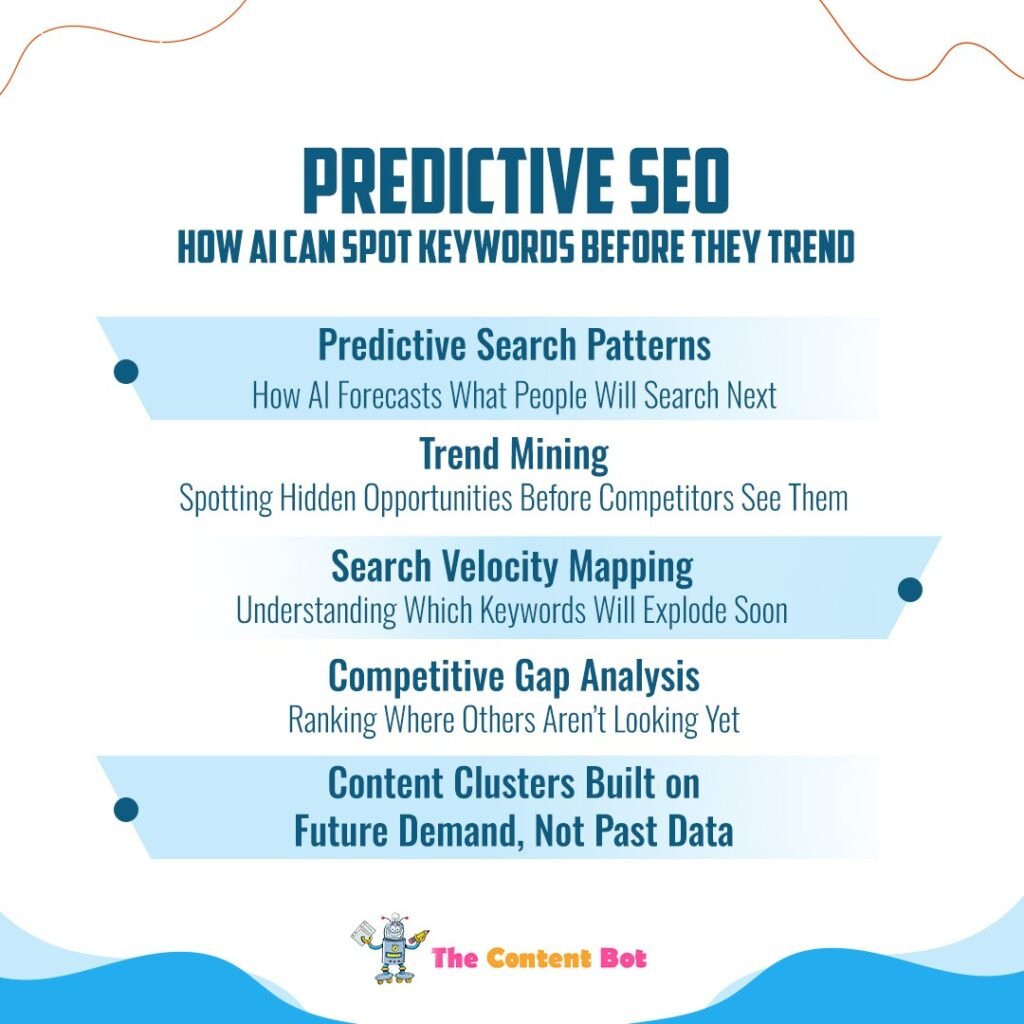
3. Search Velocity Mapping: Understanding Which Keywords Will Explode Soon
Not all keywords grow equally some rise slowly, others explode overnight.
AI maps the velocity of search interest using neural forecasting models.
It predicts:
- How fast a keyword will rise
- How long it will stay relevant
- When it will decline
- Which related terms will follow
This lets brands build content calendars around future demand, not outdated metrics.
Key Insights:
- Velocity forecasting is more accurate than raw keyword volume.
- You invest content resources where search intent is expanding.
- Predictive timing leads to faster ranking with less effort.
4. Competitive Gap Analysis: Ranking Where Others Aren’t Looking Yet
Predictive SEO isn’t just about trends it’s about opportunity gaps.
AI analyzes competitors’ content strategies and identifies keywords they haven’t targeted yet but likely will soon.
You move first. You rank first and dominate before anyone else catches up.
This creates a persistent competitive advantage especially in emerging markets.
Key Insights:
- First-mover keywords have the highest long-term ranking stability.
- AI identifies blind spots in competitors’ content clusters.
- You can own entire keyword ecosystems before the market enters.
5. Content Clusters Built on Future Demand, Not Past Data
The future of SEO isn’t single keywords it’s topic clusters.
AI helps you build clusters around predicted keyword families, ensuring:
- Strong semantic relevance
- Higher authority
- Faster ranking across interconnected topics
- Better topical completeness
You’re not just ranking for a keyword you’re owning an entire future niche.
Key Insights:
- AI maps semantic relationships long before they appear in tools like SEMrush.
- Predictive clusters increase organic traffic exponentially.
- Future-focused content ages better and ranks longer.
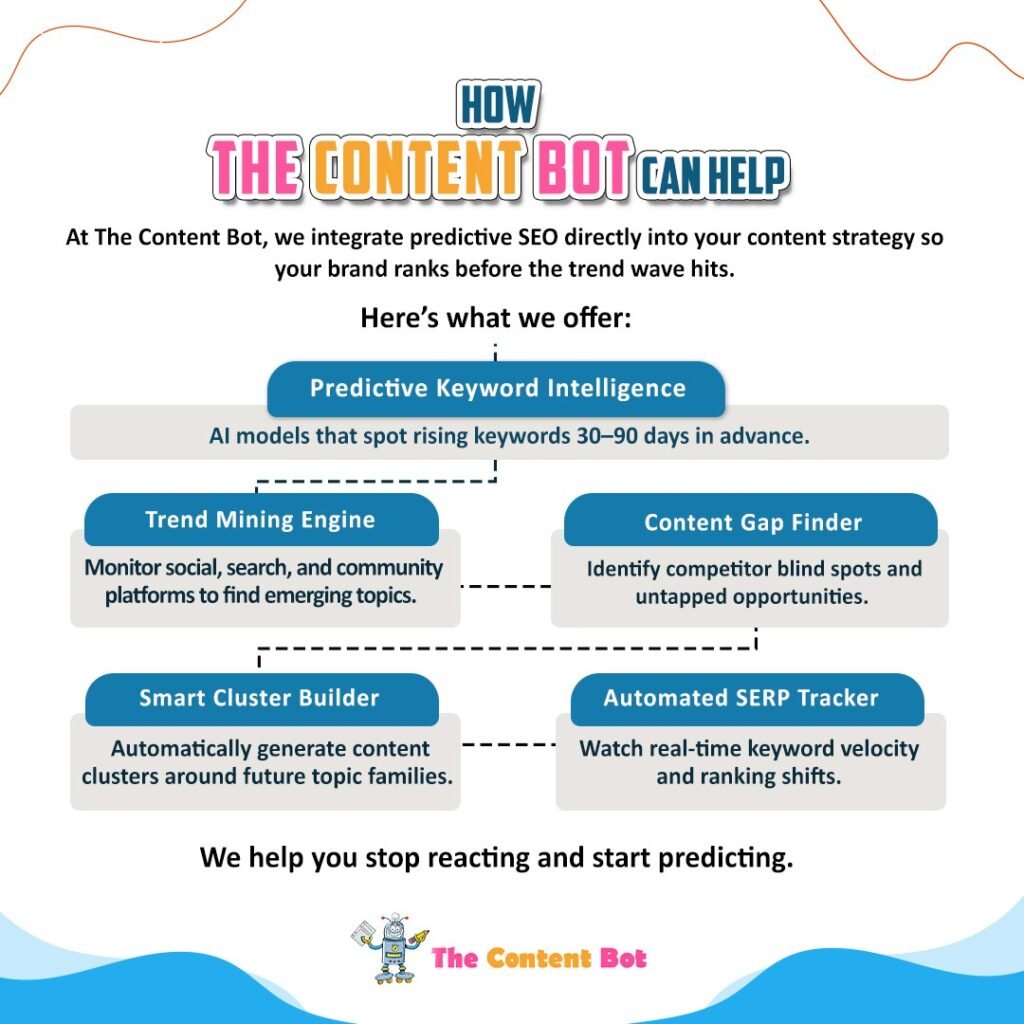
How The Content Bot Will Help
At The Content Bot, we integrate predictive SEO directly into your content strategy so your brand ranks before the trend wave hits.
Here’s what we offer:
- Predictive Keyword Intelligence: AI models that spot rising keywords 30–90 days in advance.
- Trend Mining Engine: Monitor social, search, and community platforms to find emerging topics.
- Content Gap Finder: Identify competitor blind spots and untapped opportunities.
- Smart Cluster Builder: Automatically generate content clusters around future topic families.
- Automated SERP Tracker: Watch real-time keyword velocity and ranking shifts.
We help you stop reacting
and start predicting.
Frequently Asked Questions
Can predictive SEO work for small businesses? Yes small brands benefit the most because predictive SEO levels the playing field.
How accurate is AI-powered keyword prediction? Models reach 80–92% accuracy depending on niche and data sources.
How often should predictive keywords be updated? Weekly for fast-moving industries, monthly for stable niches.
Does predictive SEO replace traditional SEO? No it enhances it by adding a future-focused layer on top of existing strategies.
Here’s How This Helps
- FinTech Startup: Used predictive SEO to rank for emerging regulatory terms → traffic +140% in 60 days.
- E-Commerce Brand: Identified rising seasonal keywords early → sales up 48% before peak season.
- Marketing Agency: Adopted predictive clusters → outranked competitors for 22 future-ready keywords.
Predictive SEO doesn’t wait for trends it anticipates them.
In a world where everyone reacts, your brand becomes the one that leads.
At The Content Bot, we help you build a search strategy that grows faster, lasts longer, and positions you at the front of every opportunity curve.
