
Most Businesses Don’t Have a Lead Problem – When sales slow down, the usual response is predictable.
Run more ads.
Post more content.
Increase outreach.
Generate more leads.
It sounds logical. More leads should create more sales.
But for many businesses, lead volume is not the real problem.
The real problem is what happens after a lead enters the system.
Enquiries go unanswered. Follow-ups arrive too late. Sales conversations feel generic. Websites fail to build confidence. Prospects receive information, but not enough clarity to make a decision.
So the business keeps spending money to bring more people into a process that is already leaking opportunities.
This creates an expensive cycle. Marketing generates attention, sales struggles to convert it, and leadership concludes that even more leads are needed.
Before increasing lead generation, businesses need to ask a harder question: are they making the most of the opportunities they already have?
1. More Leads Cannot Fix a Weak Conversion Process
A business can generate hundreds of leads and still struggle to grow.
Lead generation creates opportunities. It does not guarantee outcomes.
If the sales process is unclear, slow, or inconsistent, increasing lead volume simply creates more wasted opportunities.
Common problems include:
- Delayed responses
- Weak qualification
- Generic follow-ups
- Poor sales messaging
- Unclear next steps
- No structured nurturing process
These issues do not disappear when more leads arrive.
They become more expensive.
A business must first understand how many existing leads move from enquiry to conversation, proposal, and sale.
Without that visibility, more leads may only hide deeper problems.
Key Insight: More leads amplify the quality of your process, whether it is good or bad.
2. Slow Follow-Up Quietly Kills Opportunities
Buyer interest has a shelf life.
When someone submits an enquiry, books a demo, or asks for more information, their attention is usually highest at that moment.
Every hour of delay reduces momentum.
Yet many businesses wait a day or longer before responding.
By then, the prospect may have contacted several competitors, found another solution, or simply lost interest.
This does not mean every lead needs an aggressive sales call immediately.
It means the business should acknowledge the enquiry, provide clarity, and establish the next step while the buyer is still engaged.
Fast follow-up signals professionalism.
Slow follow-up creates doubt.
Key Insight: The value of a lead begins declining the moment it enters your pipeline.
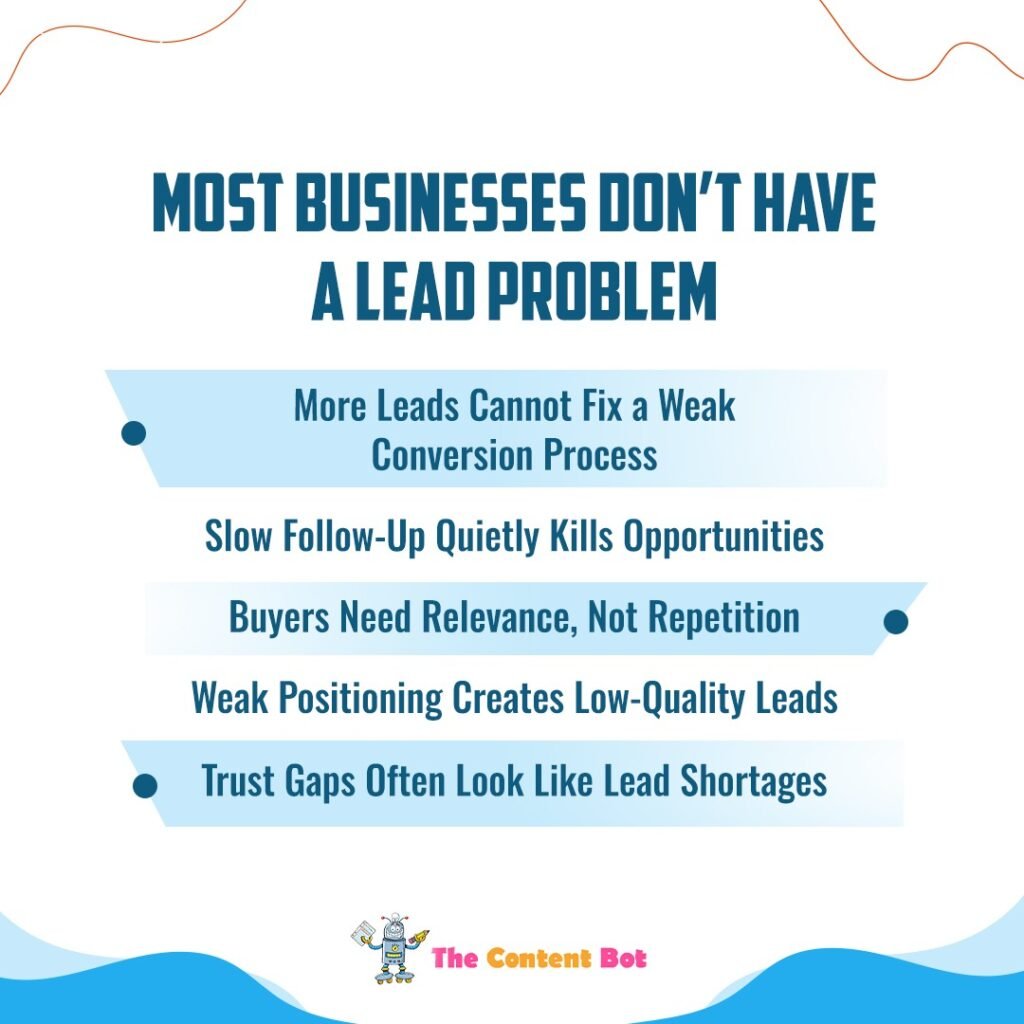
3. Buyers Need Relevance, Not Repetition
Many sales teams follow up by repeatedly asking the same question:
“Have you had a chance to review this?”
That is not nurturing. It is reminding.
Effective follow-up should help the buyer move closer to a decision.
It might include:
- A relevant case study
- An answer to a common concern
- A comparison guide
- A clear explanation of the process
- Evidence of past results
- A useful insight connected to their problem
Each interaction should give the buyer a reason to continue the conversation.
When follow-ups add no value, prospects begin to ignore them.
The issue is not always a lack of interest. Sometimes the business simply has not made the next step worth taking.
Key Insight: Good follow-up reduces uncertainty instead of repeating the sales pitch.
4. Weak Positioning Creates Low-Quality Leads
Sometimes businesses do have too many poor-fit enquiries.
But that does not automatically mean the audience is wrong.
The messaging may be attracting the wrong people.
If a website promises everything to everyone, it becomes difficult for qualified buyers to recognise whether the solution is built for them.
Vague positioning often attracts:
- Price shoppers
- Unqualified prospects
- Buyers with unrealistic expectations
- Enquiries outside the company’s expertise
- People who do not understand the value
Strong positioning filters the audience before the sales conversation begins.
It clearly communicates who the business serves, what problem it solves, and what type of outcome it creates.
This may reduce the total number of leads.
But it often improves the quality of the leads that remain.
Key Insight: Better positioning does not always create more leads. It creates better ones.
5. Trust Gaps Often Look Like Lead Shortages
A prospect may be interested in your service and still decide not to proceed.
The problem may not be the offer.
It may be a lack of trust.
Buyers look for evidence before making decisions. They want to see experience, results, expertise, and consistency.
If a business has no case studies, weak testimonials, outdated content, or unclear proof, prospects may hesitate.
From the outside, this appears to be a lead-generation issue.
But the real problem is that existing leads do not feel confident enough to move forward.
Trust is not created through claims such as “best quality” or “industry-leading service.”
It is created through visible proof.
Key Insight: Many leads do not need more persuasion. They need more confidence.
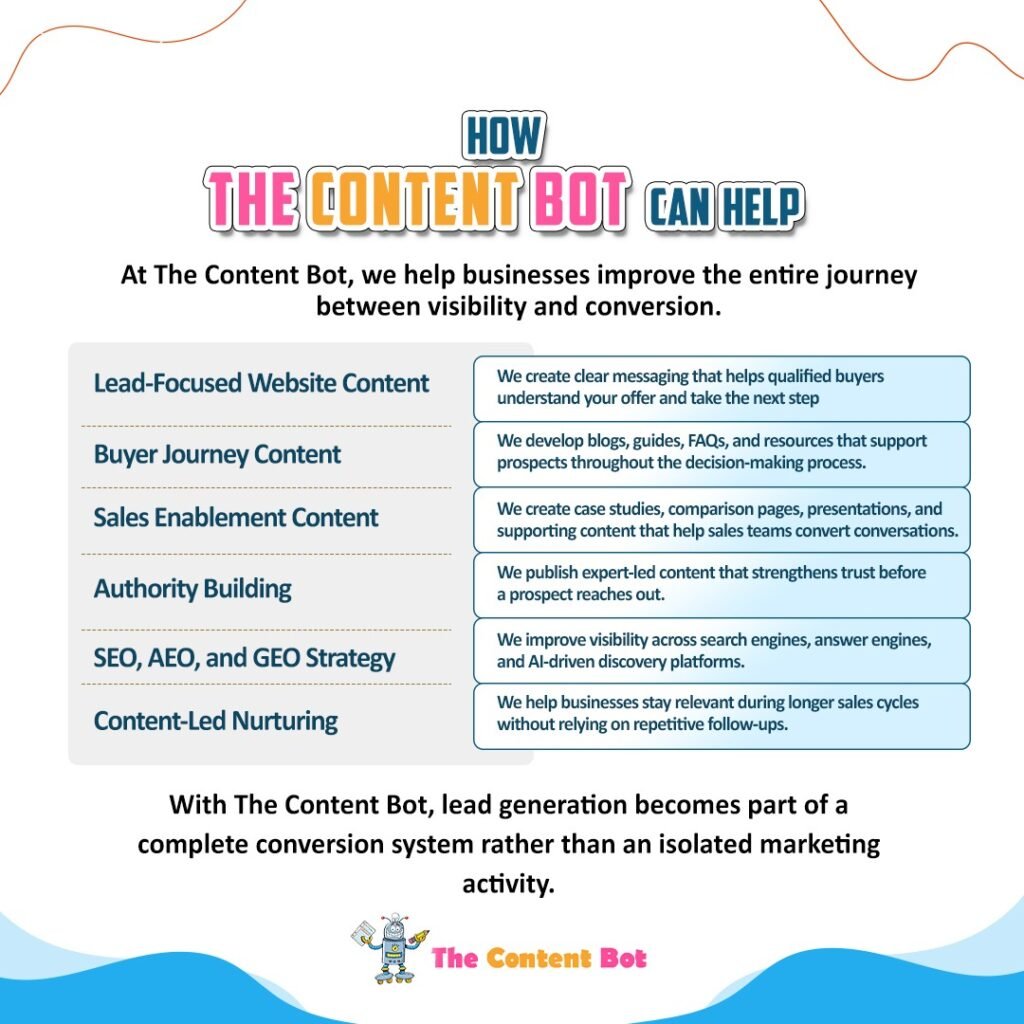
How The Content Bot Can Help
At The Content Bot, we help businesses improve the entire journey between visibility and conversion.
Lead-Focused Website Content
We create clear messaging that helps qualified buyers understand your offer and take the next step.
Buyer Journey Content
We develop blogs, guides, FAQs, and resources that support prospects throughout the decision-making process.
Sales Enablement Content
We create case studies, comparison pages, presentations, and supporting content that help sales teams convert conversations.
Authority Building
We publish expert-led content that strengthens trust before a prospect reaches out.
SEO, AEO, and GEO Strategy
We improve visibility across search engines, answer engines, and AI-driven discovery platforms.
Content-Led Nurturing
We help businesses stay relevant during longer sales cycles without relying on repetitive follow-ups.
With The Content Bot, lead generation becomes part of a complete conversion system rather than an isolated marketing activity.
Frequently Asked Questions
How do I know whether I have a lead problem or a conversion problem? Review how many enquiries become qualified conversations, proposals, and customers. A large drop between stages usually points to a conversion issue.
What is a good lead conversion rate? It varies by industry, offer, price, and lead source. The important step is measuring your current rate and identifying where prospects drop off.
Can better website content improve lead quality? Yes. Clear positioning helps the right buyers recognize your value while discouraging poor-fit enquiries.
How quickly should businesses respond to leads? As quickly as reasonably possible. A fast acknowledgement and clear next step can preserve buyer momentum.
Why do prospects stop replying after showing interest? They may lack urgency, clarity, trust, or internal approval. Follow-up content should address these barriers rather than simply ask for updates.
Should businesses stop investing in lead generation? No. But they should strengthen conversion, nurturing, and trust before significantly increasing lead volume.
Here’s How This Helps
SaaS Company Improves Demo Conversions
A SaaS business reviewed its pipeline and discovered that demo requests were being followed up too slowly. By improving response times and using product-specific case studies, it converted more existing enquiries without increasing ad spend.
Consulting Firm Attracts Better-Fit Prospects
A consulting company narrowed its positioning and rewrote its service pages around a specific buyer problem. Total enquiries declined slightly, but the number of qualified conversations increased.
IT Provider Strengthens Follow-Up
An IT services company replaced generic reminder emails with useful guides, implementation plans, and client examples. Prospects stayed engaged longer and entered sales conversations with stronger intent.
B2B Supplier Builds Buyer Confidence
A supplier added detailed case studies, testimonials, and clear process explanations to its website. Existing leads moved faster because they had fewer unanswered questions.
Lead generation matters, but it is not always the answer.
Many businesses already have enough attention, enquiries, and opportunities to grow. What they lack is a system that turns that interest into trust, momentum, and action.
Before spending more to attract new prospects, businesses should examine how quickly they respond, how clearly they communicate, how effectively they follow up, and whether buyers have enough proof to feel confident.
At The Content Bot, we help businesses strengthen every stage of that journey through strategic content, clear positioning, and buyer-focused communication.
Because the smartest growth strategy is not always finding more leads. Sometimes it is finally converting the ones you already have.
