

Memorable Content Marketing – Getting someone to read your blog is an achievement. With thousands of articles competing for attention, convincing a person to spend even a few minutes on your website is not easy.
But there is a question businesses rarely ask after publishing an article: will the reader remember who wrote it?
Think about the last useful article you read online. You probably remember something you learned from it. You might even remember a statistic, an example, or a particularly interesting explanation. But can you remember the company that published it?
For many people, the answer is no.
This is an uncomfortable reality for businesses investing in content marketing. Their articles might rank well, attract visitors, and answer customer questions, yet readers leave without developing any meaningful connection with the brand.
The content has done its job as an information resource, but it hasn’t necessarily done its job as a marketing asset.
Understanding the difference between creating useful content and creating memorable content is becoming increasingly important for businesses that want their content investments to produce long-term results.
1. Useful Content Doesn’t Automatically Build Brand Recognition
There is a common assumption in content marketing that if an article provides enough value, readers will naturally remember the company behind it.
Unfortunately, that isn’t always how people consume information.
When someone searches for an answer, their attention is usually focused on solving a particular problem. They open an article, find the relevant explanation, and move on. Unless something creates a stronger impression, the company name may barely register.
Consider a business publishing an article about reducing operational costs. The article might contain excellent advice, but if it reads like a general educational resource that could have appeared on any website, readers have little reason to associate that knowledge with a particular company.
This doesn’t mean every article needs to become a sales pitch. It means the business needs to communicate its expertise and perspective naturally throughout the content.
A useful article answers a question. A memorable article helps readers understand why the company behind it is worth listening to.
Key Insight: Being helpful earns attention, but being distinctive helps people remember where that help came from.
2. Generic Advice Makes Brands Interchangeable
One of the biggest problems with business blogging is that many articles contain almost identical recommendations.
Search for advice about improving customer retention, generating leads, or building brand authority, and you’ll encounter familiar suggestions repeated across dozens of websites.
Understand your audience. Create valuable content. Maintain consistency. Measure your results.
None of these recommendations is necessarily wrong. The problem is that they rarely provide anything a reader couldn’t find elsewhere.
Businesses sometimes mistake covering a topic thoroughly for contributing something meaningful to it.
A company with ten years of experience working with manufacturing businesses should have insights that differ from those of a company serving software startups. Their customers face different challenges, their buying processes work differently, and their experiences should influence the advice they share.
When that experience disappears from the writing, the content becomes interchangeable.
Readers may appreciate the information without developing any particular reason to remember its source.
Key Insight: If your article could appear on a competitor’s website without changing a word, your brand is probably missing from the content.
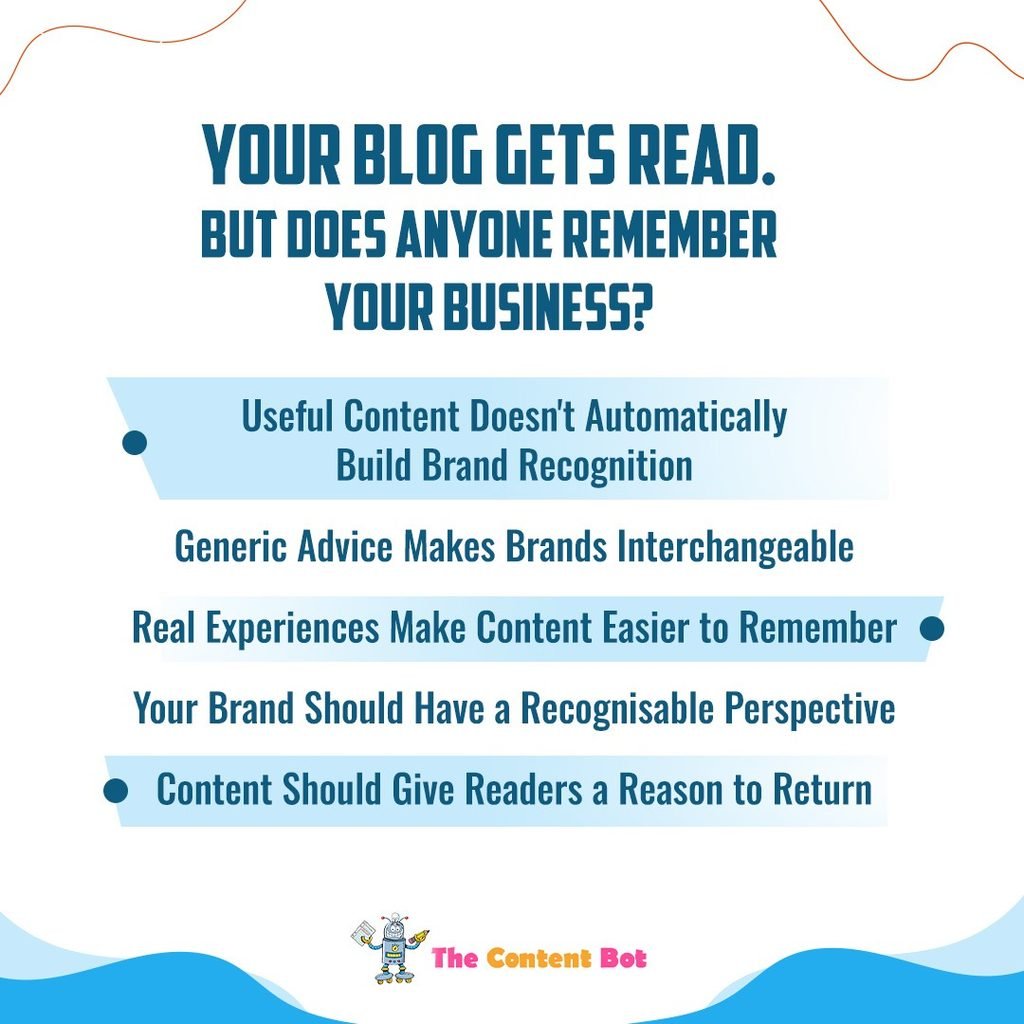
3. Real Experiences Make Content Easier to Remember
People tend to connect with specific experiences more easily than abstract recommendations.
Imagine reading two articles about website conversions.
The first explains that businesses should improve their calls-to-action, simplify navigation, and build trust.
The second describes a situation where a company was attracting relevant visitors but struggling to generate enquiries because its service pages never explained what happened after someone submitted a form.
Both articles communicate useful information. However, the second gives readers a situation they can picture and compare with their own business.
That is the value of experience-led content.
Businesses accumulate valuable knowledge through customer conversations, projects, mistakes, experiments, and everyday operations. Yet much of this knowledge never reaches their blogs.
Instead, they publish broad advice that sounds similar to everything else available online.
Including real observations, specific examples, and lessons from experience makes content more relatable. It also demonstrates that the company understands the subject beyond its theoretical explanation.
Key Insight: Readers may forget general advice, but a relevant experience can stay with them long after they leave the page.
4. Your Brand Should Have a Recognisable Perspective
A business doesn’t need to mention its company name in every paragraph to build brand recognition.
What it needs is a consistent way of approaching the subjects it discusses.
For example, one marketing company might approach every topic through customer psychology. Another might focus on measurable commercial outcomes. A third might specialise in the technical systems that support marketing performance.
All three could write about the same subject and produce completely different articles.
That difference is valuable.
Over time, readers begin recognising what a company stands for, what it prioritises, and how it thinks about industry challenges.
This is particularly important for businesses publishing regularly. If every article adopts a different tone, perspective, and level of expertise, the content library can feel disconnected.
Consistency should not mean repeating the same phrases. It should mean maintaining a recognisable point of view while exploring different subjects.
Key Insight: A memorable brand isn’t built by repeating its name. It’s built by consistently demonstrating how it thinks.
5. Content Should Give Readers a Reason to Return
Most businesses evaluate blog performance through search rankings, impressions, traffic, and conversions.
These metrics are important, but they don’t capture the entire value of content.
Consider two readers.
The first visits your website, finds an answer, and leaves without remembering anything about the company.
The second finds the same answer but also discovers an interesting perspective, a useful example, and another article that addresses a related challenge.
The second reader has a stronger reason to return.
This is why businesses should think about their blogs as connected learning experiences rather than collections of isolated articles.
Relevant internal links, related resources, practical guides, newsletters, and consistent subject expertise can encourage readers to explore further.
Not everyone will become a customer immediately. In B2B markets, buying decisions can take considerable time.
However, if your content repeatedly helps someone make better decisions, your business has more opportunities to become familiar and trusted.
Key Insight: The real value of content grows when readers have a reason to come back, not just a reason to click once.
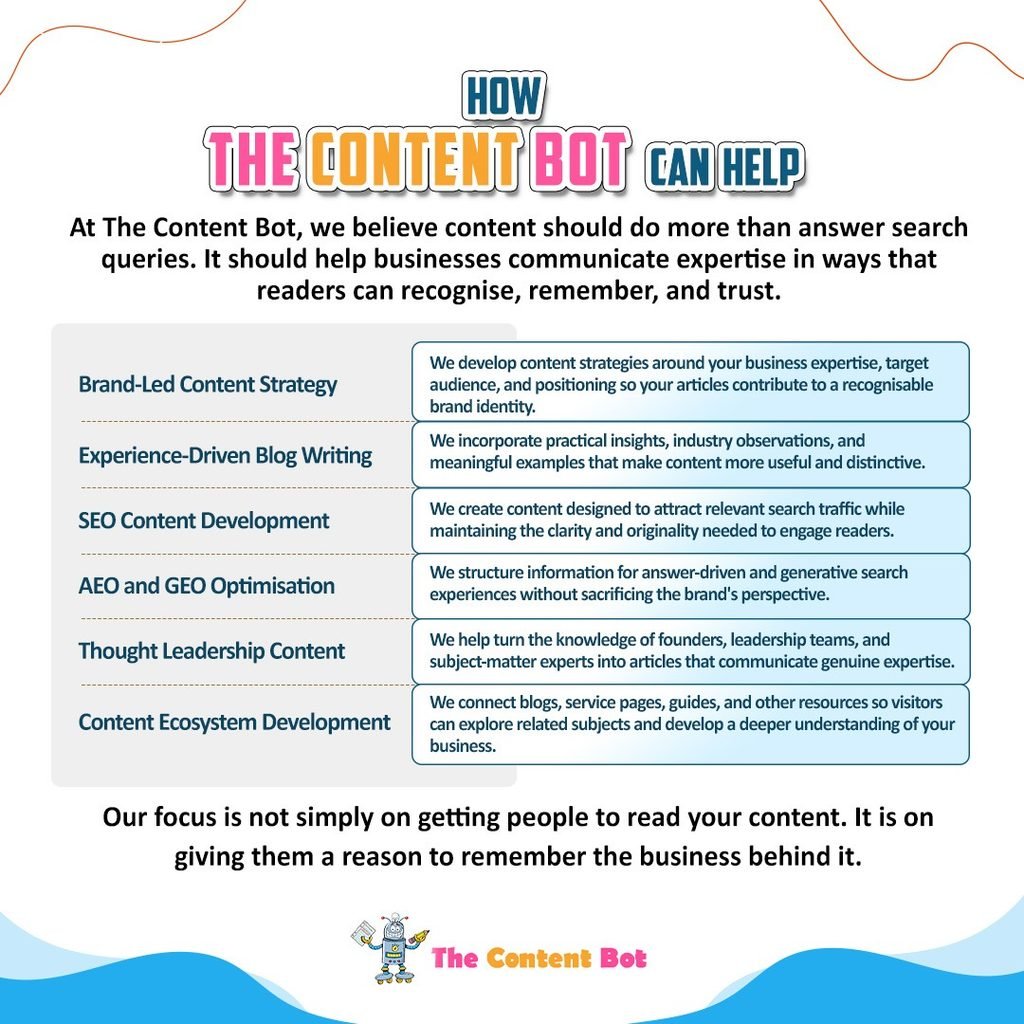
How The Content Bot Can Help
At The Content Bot, we believe content should do more than answer search queries. It should help businesses communicate expertise in ways that readers can recognize, remember, and trust.
Brand-Led Content Strategy
We develop content strategies around your business expertise, target audience, and positioning so your articles contribute to a recognizable brand identity.
Experience-Driven Blog Writing
We incorporate practical insights, industry observations, and meaningful examples that make content more useful and distinctive.
SEO Content Development
We create content designed to attract relevant search traffic while maintaining the clarity and originality needed to engage readers.
AEO and GEO Optimisation
We structure information for answer-driven and generative search experiences without sacrificing the brand’s perspective.
Thought Leadership Content
We help turn the knowledge of founders, leadership teams, and subject-matter experts into articles that communicate genuine expertise.
Content Ecosystem Development
We connect blogs, service pages, guides, and other resources so visitors can explore related subjects and develop a deeper understanding of your business.
Our focus is not simply on getting people to read your content. It is on giving them a reason to remember the business behind it.
Frequently Asked Questions
Why do people read blogs without remembering the brand? Most readers arrive with a specific information need. If the article provides an answer but offers no distinctive perspective, experience, or connection to the company, readers may remember the information without remembering its source.
How can businesses improve brand recognition through blogs? Businesses can develop a consistent perspective, include relevant experiences, communicate their expertise clearly, and connect articles to other useful resources.
Should every blog promote the company’s services? No. Excessive promotion can make educational content less useful. Service references should appear naturally when they help readers understand how the company can address a relevant problem.
Does storytelling improve content marketing? Relevant stories and examples can make complex information easier to understand and remember. However, stories should support the topic rather than distract from it.
How can businesses measure whether their content is memorable? Returning visitors, branded searches, direct traffic, newsletter subscriptions, engaged readership, and assisted conversions can provide useful signals, although none measures brand recall perfectly.
Is brand-focused content important for SEO and AI search? Yes. Clear expertise, useful information, and consistent positioning can support both search visibility and brand recognition. However, no content format guarantees rankings or inclusion in AI-generated answers.
Here’s How This Helps
SaaS Company Develops a Recognisable Content Style
A SaaS company publishes educational articles about productivity software but struggles to differentiate its content from competitors. Instead of repeating general productivity advice, it begins incorporating insights from common implementation challenges, customer questions, and product use cases. The content becomes more closely connected to the company’s expertise.
Consulting Firm Makes Its Expertise More Visible
A consulting business has experienced professionals, but its website contains mostly generic management advice. By developing articles around the practical observations of its consultants, the company creates resources that better reflect the knowledge clients are actually paying for.
Manufacturing Business Explains Real-World Applications
A manufacturing company publishes technical information about its products but rarely discusses how customers use them. By adding application examples, selection guidance, and explanations of common technical challenges, the content becomes more relevant to prospective buyers.
B2B Service Provider Builds Returning Readership
A service provider organises its blog around a series of connected customer challenges. Instead of treating each article as a separate publishing task, it creates useful pathways between related resources, giving interested readers reasons to continue exploring the website.
Getting people to visit your blog is important, but it should not be the final objective of content marketing.
A successful article should provide useful information while also strengthening the reader’s understanding of the company behind it. That requires more than good keywords, attractive headlines, and regular publishing.
Businesses need to bring their actual expertise into their content. They need to communicate a recognisable perspective, explain ideas through relevant experiences, and create resources that give readers a reason to return.
As more businesses compete for attention through search engines and AI-driven discovery, content that feels generic will have a harder time creating a lasting impression.
At The Content Bot, we help businesses create content that combines discoverability with genuine brand value.
Because attracting a reader is one achievement. Becoming a business they remember is another.
