
Competitors Sound Exactly Like You – Spend ten minutes browsing websites in almost any B2B industry and something strange starts to happen. After the third or fourth website, they begin to sound like the same company.
Everyone is “customer-centric.” Everyone provides “innovative solutions.” Everyone has an “experienced team” committed to “delivering excellence.” Replace the logo at the top of the page and, in many cases, the copy could belong to any competitor in the market.
The problem is not that these statements are necessarily false. The problem is that they tell a prospective customer almost nothing about why one business should be chosen over another.
This is becoming an even bigger issue as businesses produce more content across websites, blogs, LinkedIn, email, and AI-driven search environments. There is more content competing for attention than ever, yet much of it sounds remarkably similar.
If your customers cannot tell the difference between you and three competitors after visiting your websites, you do not have a content-volume problem. You have a positioning problem.
1. Safe Marketing Language Is Usually Forgettable
Most generic business copy begins with good intentions. Nobody wants a homepage to sound unprofessional, so companies gravitate towards language that feels safe. Words such as “reliable,” “innovative,” “leading,” “quality,” and “trusted” are easy to approve because nobody inside the organisation is likely to disagree with them.
Unfortunately, customers have heard these words thousands of times. Saying that you provide “high-quality solutions tailored to customer needs” does not give a buyer anything concrete to remember. Your competitors are probably making almost exactly the same claim.
Specificity is far more powerful. Instead of saying that your company provides personalised solutions, explain what you actually do differently. Perhaps every project begins with a technical audit. Maybe customers work directly with a senior specialist rather than an account manager. Perhaps your implementation process takes two weeks when the industry normally takes six. Those details give people something they can understand and compare.
Key Insight: Professional language makes you sound credible, but specific language makes you memorable.
2. Your Difference May Already Exist Inside the Business
Companies sometimes spend weeks trying to invent a clever differentiator when the real one is already sitting inside their operations.
Talk to the founder and you may discover why the company was originally created. Speak with the sales team and you will hear why customers switch from competitors. Ask customer support what clients appreciate most and you may hear something that has never appeared on the website.
Maybe customers value how quickly your team responds when something goes wrong. Perhaps your engineers explain technical problems without hiding behind jargon. Maybe your company refuses to recommend an expensive solution when a simpler one will work perfectly well.
None of these differences needs a dramatic slogan. They simply need to be noticed and communicated.
Some of the strongest positioning comes from ordinary things a company does unusually well. The problem is that businesses often stop noticing these things because they have become normal internally.
Key Insight: Your strongest differentiator may be something your team considers completely ordinary.
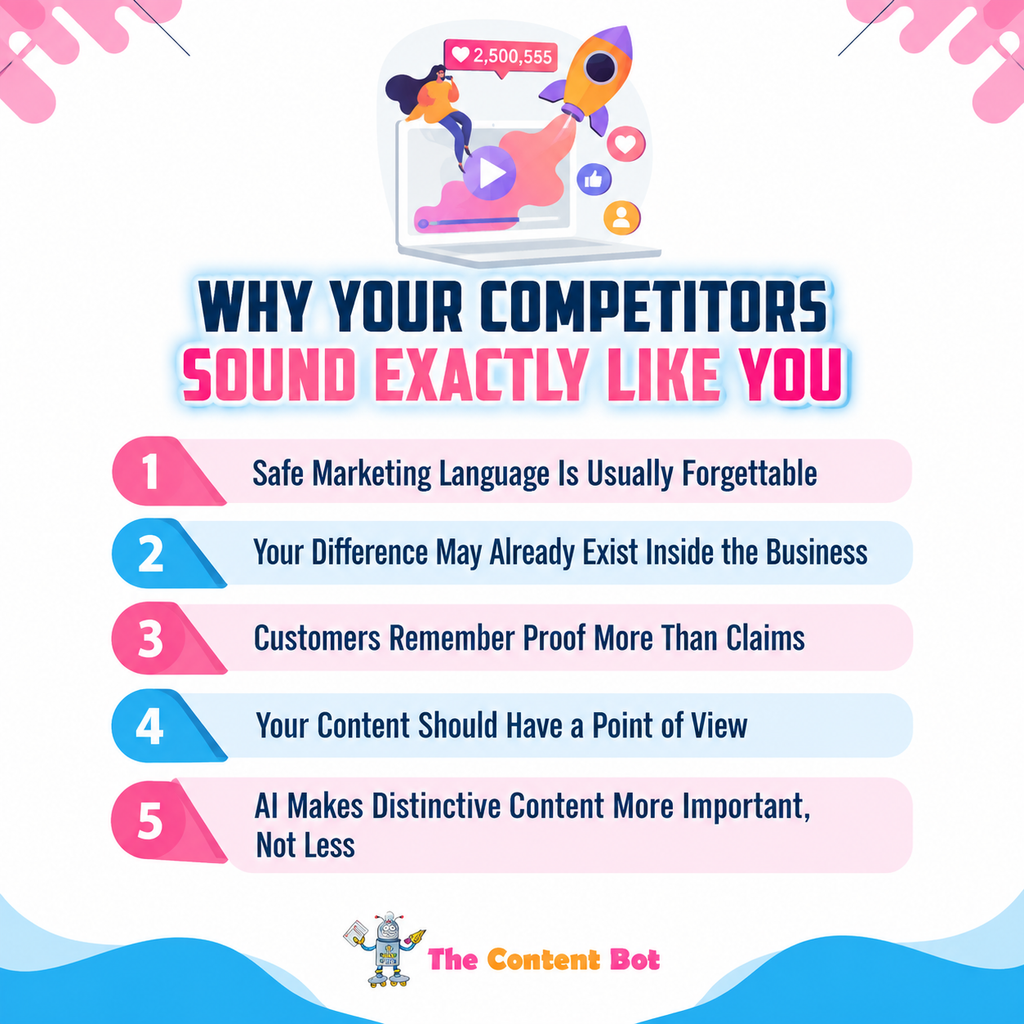
3. Customers Remember Proof More Than Claims
There is another reason so many websites sound identical: they rely heavily on adjectives.
“We are experienced.”
“We are reliable.”
“We deliver exceptional results.”
A customer cannot easily verify any of those statements. They are claims made by the company about itself.
Proof works differently.
Instead of saying you are experienced, show the types of problems you have solved over the years. Instead of describing your service as reliable, explain how your process prevents delays. Instead of claiming that customers achieve great results, show a case study demonstrating what changed.
The difference may seem small, but the effect on credibility is significant. Anyone can write a flattering sentence about their own business. Evidence gives the buyer something independent to evaluate.
This is particularly important in B2B markets where choosing the wrong provider can cost a company money, time, and reputation. Buyers are not simply looking for impressive promises. They are looking for reasons to believe them.
Key Insight: The strongest marketing claims are the ones you do not need to make because the evidence makes them for you.
4. Your Content Should Have a Point of View
A business can publish every week and still remain completely forgettable.
This usually happens when its content explains topics correctly but never says anything distinctive about them. The article contains definitions, lists, tips, and best practices, yet the reader finishes without learning how the company itself thinks.
Expertise becomes much more interesting when there is perspective behind it.
If your team believes that businesses obsess too much about traffic and not enough about conversion, explain why. If you think companies are rushing into AI-generated content without building genuine subject expertise, make the argument. If years of client work have taught you that a commonly recommended strategy rarely works in a particular situation, share that experience.
You do not need to manufacture controversy. A genuine point of view comes from experience. It is simply your interpretation of what you have repeatedly seen work, fail, or change.
That is difficult for competitors to copy because they have not lived through exactly the same experiences.
Key Insight: Information can be copied. Experience and perspective are much harder to imitate.
5. AI Makes Distinctive Content More Important, Not Less
AI has made producing competent marketing copy incredibly easy. A business can generate a respectable service page, blog article, email, or social post in minutes.
That convenience creates a new problem.
If everyone starts with the same general information, follows similar structures, and publishes similar advice, the internet becomes flooded with content that is technically correct but remarkably interchangeable.
This is where human expertise becomes more valuable.
Real customer conversations, internal data, mistakes, lessons, case studies, opinions, processes, examples, and observations give content texture. They make it sound like it came from a company that actually operates in the industry rather than from someone summarising the industry from a distance.
AI can help businesses produce content, but it cannot replace the experiences that make the business worth listening to in the first place.
The companies that understand this will use technology to communicate their expertise more effectively rather than allowing technology to flatten their expertise into generic copy.
Key Insight: As generic content becomes easier to produce, genuine experience becomes a stronger competitive advantage.
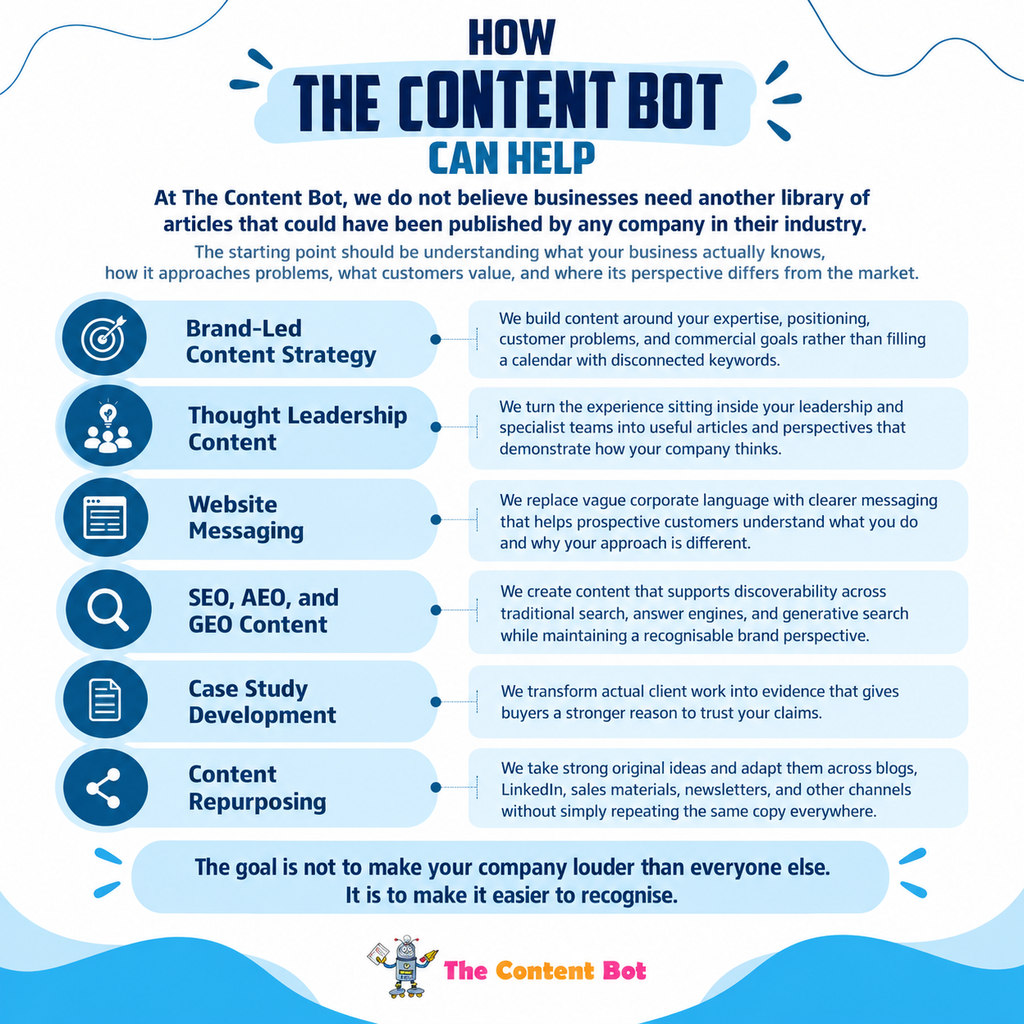
How The Content Bot Can Help
At The Content Bot, we do not believe businesses need another library of articles that could have been published by any company in their industry. The starting point should be understanding what your business actually knows, how it approaches problems, what customers value, and where its perspective differs from the market.
Brand-Led Content Strategy
We build content around your expertise, positioning, customer problems, and commercial goals rather than filling a calendar with disconnected keywords.
Thought Leadership Content
We turn the experience sitting inside your leadership and specialist teams into useful articles and perspectives that demonstrate how your company thinks.
Website Messaging
We replace vague corporate language with clearer messaging that helps prospective customers understand what you do and why your approach is different.
SEO, AEO, and GEO Content
We create content that supports discoverability across traditional search, answer engines, and generative search while maintaining a recognisable brand perspective.
Case Study Development
We transform actual client work into evidence that gives buyers a stronger reason to trust your claims.
Content Repurposing
We take strong original ideas and adapt them across blogs, LinkedIn, sales materials, newsletters, and other channels without simply repeating the same copy everywhere.
The goal is not to make your company louder than everyone else. It is to make it easier to recognise.
Frequently Asked Questions
Why does so much B2B content sound the same? Businesses often rely on safe industry terminology and generic claims because they are easy to approve. Over time, competitors end up using similar language even when their actual businesses are quite different.
How can I make my brand content more distinctive? Start with real experiences rather than adjectives. Customer conversations, internal processes, case studies, founder perspectives, mistakes, and lessons usually produce more distinctive material than generic industry topics.
Does having a point of view hurt SEO? Not inherently. Search-focused content can still contain original expertise and perspective. SEO should help people discover useful content, not force every company to sound identical.
Should every blog contain an opinion? No. Some topics simply require a clear factual explanation. However, where your company has genuine experience or a useful perspective, including it can make the content considerably more valuable.
Can AI-generated content damage brand differentiation? It can if businesses publish generic outputs without adding expertise, examples, verification, or a distinct perspective. The issue is not simply using AI. It is publishing content that could belong to anyone.
How do we find our company’s unique point of view? Speak with founders, sales teams, subject-matter experts, customer-facing employees, and customers themselves. Look for recurring beliefs, processes, frustrations, lessons, and approaches that distinguish how your company works.
Here’s How This Helps
SaaS Company Stops Sounding Like Every Other Platform
A SaaS company notices that its website uses the same language as nearly every competitor in the category. Instead of rewriting those phrases with different adjectives, the company begins explaining the specific operational problem that led to the product being created and the approach its team takes differently. The message becomes easier for prospective customers to understand and remember.
Consulting Firm Turns Experience Into Thought Leadership
A consulting firm’s experts have spent years solving complex client problems, but its blog contains mostly generic business advice. By interviewing those consultants and turning recurring observations into articles, the company begins publishing ideas that genuinely reflect its experience rather than information available everywhere else.
Manufacturer Replaces Claims With Evidence
A manufacturer repeatedly describes itself as reliable and quality-focused but provides little evidence. It begins publishing detailed project examples, explaining quality-control processes, and showing how technical decisions are made. Prospective buyers can now see the reasons behind those claims instead of simply being asked to believe them.
B2B Service Provider Builds a Recognisable Voice
A service company stops copying the formal language common across its industry and begins explaining complicated subjects in the straightforward language its team uses with customers every day. Over time, its articles begin to feel recognisably connected to the company rather than interchangeable with competitor content.
Your competitors do not need to copy your website for your business to become indistinguishable from them. If everyone uses the same claims, publishes the same topics, and repeats the same industry language, differentiation disappears on its own.
The answer is not to become louder or deliberately controversial. It is to become more specific.
Talk about what you have actually learned. Explain how you really work. Show evidence instead of stacking up adjectives. Answer the questions your customers genuinely ask and allow your experience to shape the way you discuss your industry.
At The Content Bot, we help businesses turn those experiences into content that people can recognise, trust, and remember.
Because sounding professional is easy. Sounding unmistakably like your business is much harder, and far more valuable.
