
Prospects agree but don’t buy nod, they say “makes sense” … and then disappear. Here’s what’s actually going on.
You explain your offer clearly.
The prospect understands the problem.
They agree with your approach.
They even tell you your solution sounds exactly like what they need.
And then the conversation ends with:
“Let me think about it.”
No payment. No commitment. No next step.
This happens to far more businesses than people admit.
Most founders assume it’s because:
- the pricing is high,
- the prospect isn’t serious,
- or the follow-up wasn’t strong enough.
But the real issue usually sits much deeper.
The problem is that most businesses are creating agreement, not decisionmomentum.
And there’s a massive difference between the two.
1. Agreement Does Not Automatically Create Urgency
A prospect can completely agree with your logic and still postpone the decision for weeks or months.
Why?
Because understanding a problem and feeling the urgency to solve it are two different things.
Most sales conversations focus heavily on explaining:
- the service,
- the process,
- the benefits,
- and the deliverables.
But buyers move when they emotionally feel the consequences of staying where they are.
If your messaging only educates, it creates awareness.
If it creates emotional clarity, it creates action.
Key Insight: People buy when acting feels more important than waiting.
2. Too Much Information Can Slow Down Decisions
Many businesses think more information builds trust.
Sometimes it does.
But when prospects receive too many details without direction, they enter evaluation mode instead of decision mode.
Now they start:
- comparing,
- researching,
- delaying,
- and exploring alternatives.
Instead of simplifying the buying decision, the sales process accidentally makes the decision heavier.
The best sales systems create clarity, not confusion.
Key Insight: Over-explaining often creates hesitation instead of confidence.
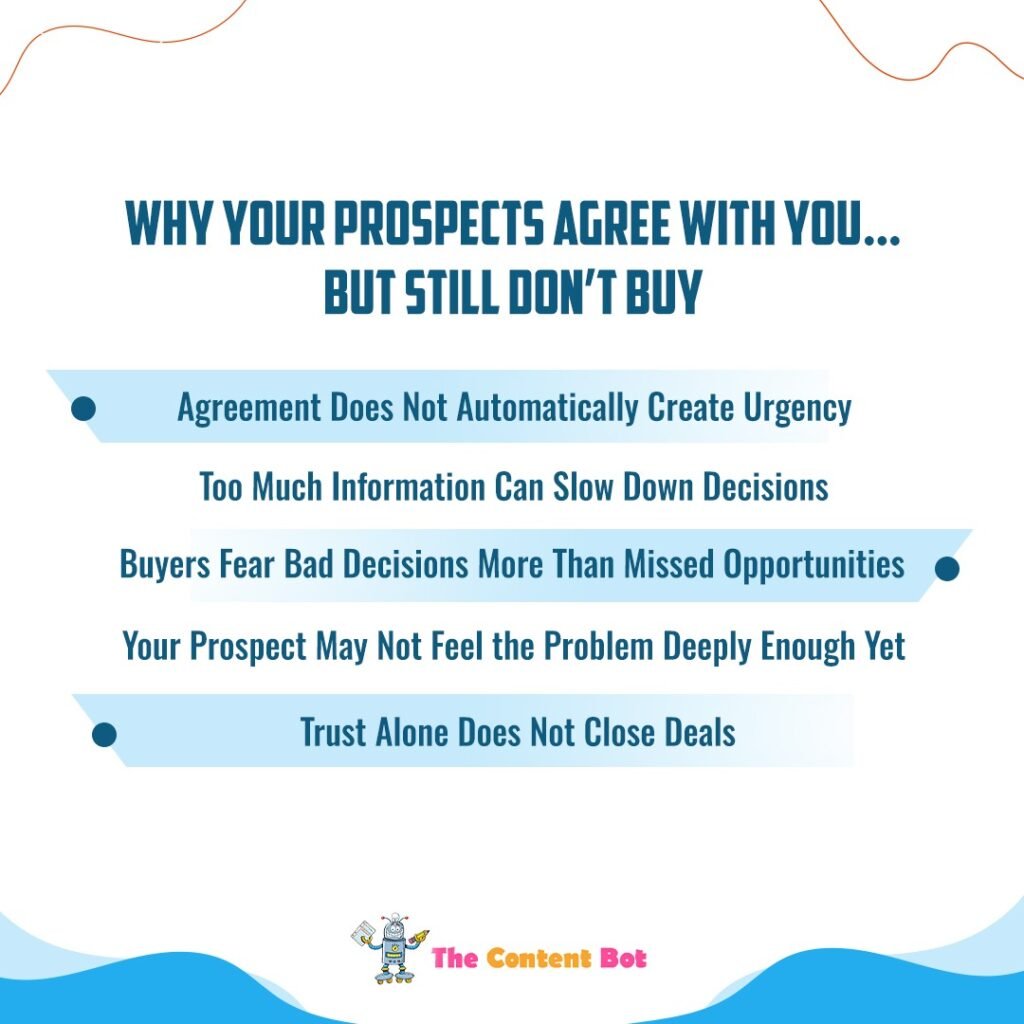
3. Buyers Fear Bad Decisions More Than Missed Opportunities
Most buyers are not asking:
“Will this help me grow?”
They are silently asking:
“What if this fails?”
This is where many businesses lose deals.
They focus entirely on promoting results but forget to reduce perceived risk.
When uncertainty feels high, buyers delay action — even if they like the solution.
The safer inaction feels, the longer the decision gets postponed.
Key Insight: The fear of making the wrong decision is often stronger than the desire for growth.
4. Your Prospect May Not Feel the Problem Deeply Enough Yet
A buyer may understand they have:
- weak marketing,
- low conversions,
- poor visibility,
- or inconsistent leads.
But if the pain hasn’t emotionally affected them yet, the urgency stays low.
This is why many prospects continue operating with broken systems for years.
Not because they disagree.
But because the consequences haven’t become painful enough to force change.
Key Insight: Problems that feel manageable rarely get prioritized.
5. Trust Alone Does Not Close Deals
A lot of businesses focus entirely on:
- posting content,
- building authority,
- showing expertise,
- and gaining attention.
That helps people trust the brand.
But trust without direction often creates passive audiences instead of paying clients.
Your funnel should not just make buyers like you.
It should guide them toward a clear buying decision with confidence and momentum.
Key Insight: Trust keeps you in consideration. Decision structure creates conversions.
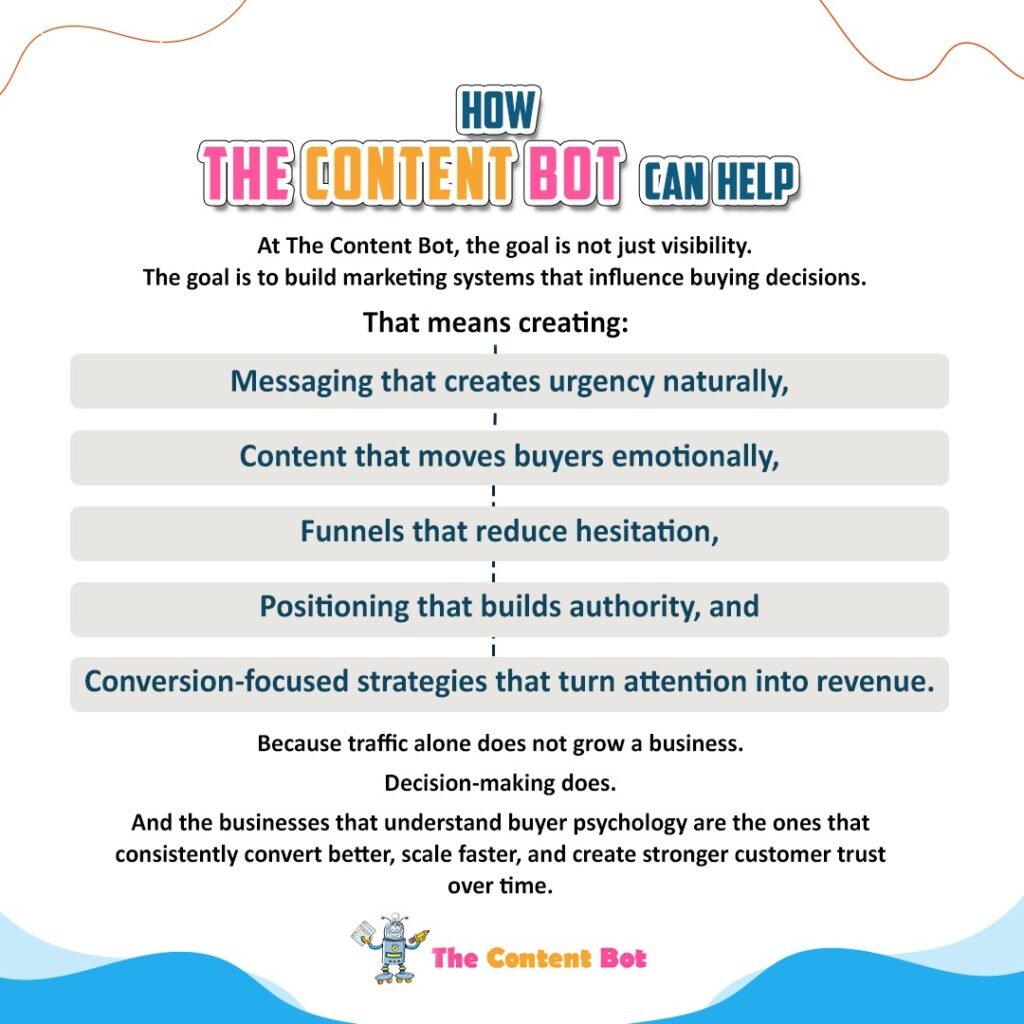
How The Content Bot Can Help
At The Content Bot, the goal is not just visibility.
The goal is to build marketing systems that influence buying decisions.
That means creating:
- messaging that creates urgency naturally,
- content that moves buyers emotionally,
- funnels that reduce hesitation,
- positioning that builds authority,
- and conversion-focused strategies that turn attention into revenue.
Because traffic alone does not grow a business.
Decision-making does.
And the businesses that understand buyer psychology are the ones that consistently convert better, scale faster, and create stronger customer trust over time.
Here’s How This Helps
Scenario 1: The “Interested” Prospect Who Never Converts
A founder spends an hour on a discovery call explaining their service in detail.
The prospect agrees with every point and even compliments the strategy.
But after the call, they disappear completely.
The problem was not the offer.
The prospect understood everything logically but never emotionally felt the urgency to act immediately.
Scenario 2: Too Much Information, Too Little Direction
A marketing agency sends a proposal filled with detailed strategies, technical terms, and multiple package options.
The client becomes overwhelmed and delays the decision for weeks while “reviewing internally.”
Instead of simplifying the buying process, the proposal increased friction and uncertainty.
Scenario 3: Fear of Making the Wrong Investment
A business owner knows their website is underperforming and costing them leads.
But they previously worked with an agency that failed to deliver results.
Now even a good solution feels risky.
The hesitation is not about understanding the value.
It is about fear of repeating a bad decision.
Frequently Asked Questions
Why do prospects agree but still delay decisions? Because agreement creates understanding, not urgency.
Is this always a pricing issue? No. In many cases, the real issue is hesitation, uncertainty, or lack of emotional urgency.
Can content improve conversions? Yes if the content is designed to influence decisions, not just educate audiences.
Why do some prospects keep saying “I’ll think about it”? Because the perceived risk of action still feels higher than the pain of inaction.
What is the biggest mistake businesses make during sales? Overloading buyers with information without creating clear decision momentum.
Does authority automatically increase conversions? Not always. Authority builds trust, but trust alone does not force action.
How can businesses reduce buyer hesitation? By simplifying decisions, reducing uncertainty, and clearly communicating consequences of delay.
One of the biggest misconceptions in sales is believing that agreement means the deal is close.
It doesn’t. A buyer can fully understand your value and still delay taking action.
Because decisions are rarely driven by logic alone.
They are influenced by:
- urgency,
- emotional clarity,
- perceived risk,
- confidence,
- and timing.
The businesses that grow consistently are not just the ones that explain their services well.
They are the ones that understand how buyers actually make decisions.
