
Long-form content that ranks . Everyone knows long-form content performs better but few understand why.
It’s not about word count anymore. In 2025, search engines reward content that builds topic authority, maximizes reader retention, and signals trustworthiness through structure, data, and engagement depth.
This blog dissects the science behind why long-form content dominates rankings and how your brand can use that science to win the SEO game, consistently.
1. Depth Over Length: Why Google Rewards Comprehensiveness, Not Fluff
Gone are the days when 2,000 words automatically meant “authority.”
Now, algorithms analyze whether your content answers all search intents behind a keyword informational, navigational, and transactional.
The sweet spot lies in depth, not density. Google’s semantic indexing measures how complete, structured, and solution-oriented your content is.
Key Insights:
- Cover multiple related subtopics to capture secondary intent.
- Use structured hierarchy (H2s, H3s) to signal completeness.
- Remove repetition; every sentence must move the idea forward.
2. Engagement Time: The Real Ranking Factor Nobody Talks About
Dwell time the duration a reader spends on your page is one of the strongest behavioral signals for search engines.
Long-form content wins here because it keeps users engaged longer through storytelling, visuals, and clarity-driven formatting.
The more time readers spend, the stronger the trust signal.
Key Insights:
- Hook in the first 3 lines with relevance, not fluff.
- Use subheadings every 250 words to break reading fatigue.
- Embed visuals or examples every 400 words to reset attention.
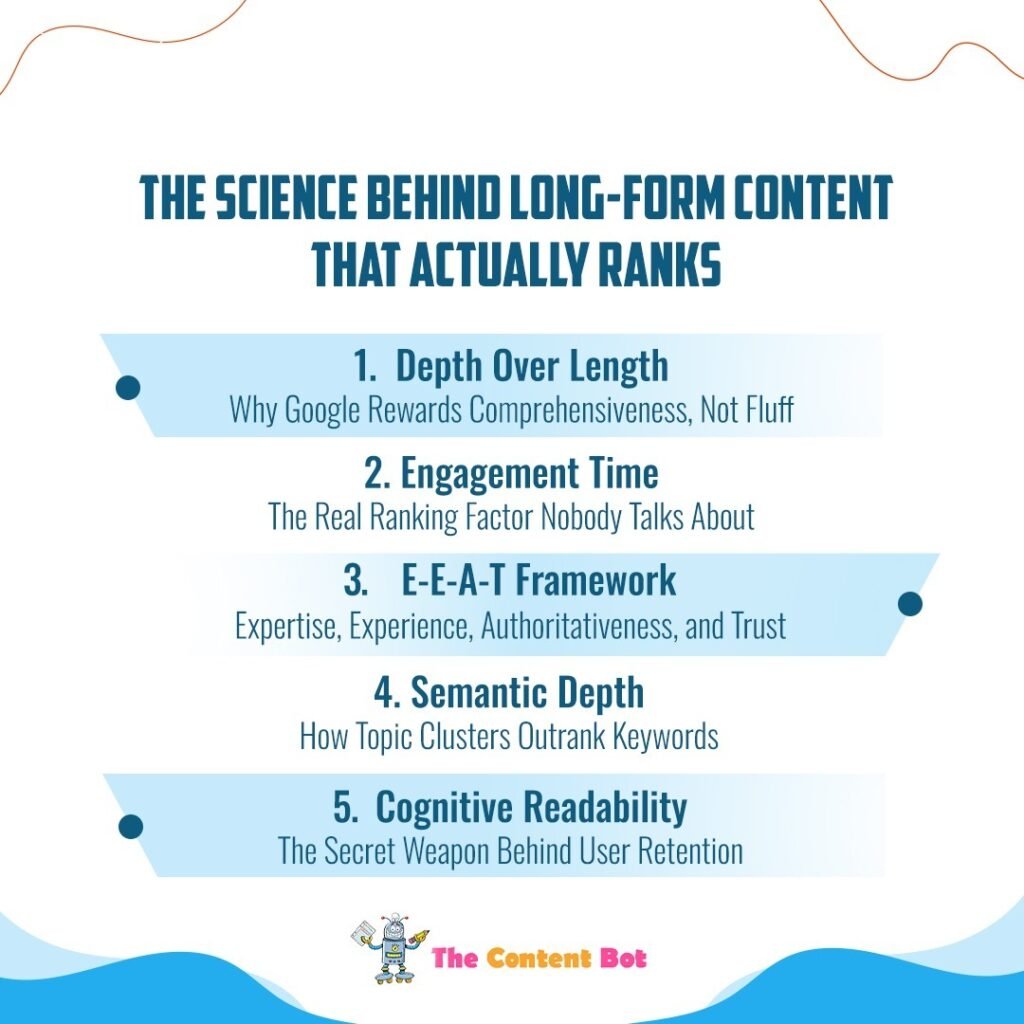
3. E-E-A-T Framework: Expertise, Experience, Authoritativeness, and Trust
Google’s modern ranking system prioritizes human authority.
Long-form content allows writers to showcase expertise, build credibility through data, and include firsthand experience all critical to E-E-A-T compliance.
Case studies, original insights, and citations aren’t optional anymore they’re ranking fuel.
Key Insights:
- Cite credible sources and include original opinions.
- Add bylines with author credentials or experience blurbs.
- Avoid generic filler specificity wins.
4. Semantic Depth: How Topic Clusters Outrank Keywords
Search engines no longer rely on one keyword per post. They analyze semantic relationships how deeply and cohesively your content connects ideas.
That means building content clusters: one in-depth pillar (the long-form article) surrounded by shorter supporting blogs interlinked strategically.
This builds “topical authority,” signaling to Google that your brand owns that subject.
Key Insights:
- Interlink high-authority blogs to reinforce cluster strength.
- Use natural variations of your focus keyword.
- The longer the dwell chain between blogs, the stronger the ranking network.
5. Cognitive Readability: The Secret Weapon Behind User Retention
Long-form doesn’t mean hard-to-read. The most successful content uses simple language, logical flow, and visual breaks to keep readers’ cognitive load light.
Think like a UX designer optimize white space, sentence rhythm, and font hierarchy for scroll comfort.
Key Insights:
- Readability = retention. Don’t overcomplicate your message.
- Use conversational tone + short paragraphs for flow.
- Content that “feels light” performs heavier in search results.
How The Content Bot Will Help
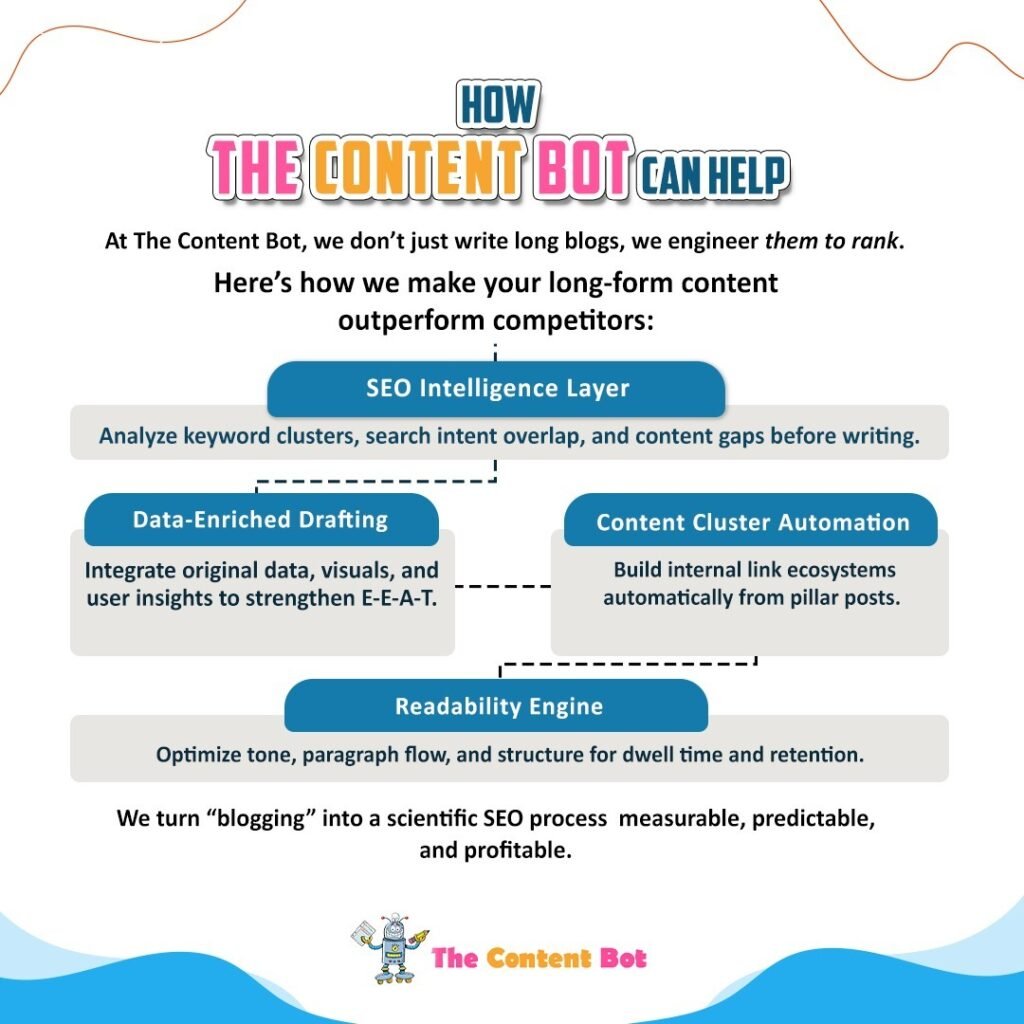
At The Content Bot, we don’t just write long blogs we engineer them to rank.
Here’s how we make your long-form content outperform competitors:
- SEO Intelligence Layer: Analyze keyword clusters, search intent overlap, and content gaps before writing.
- Data-Enriched Drafting: Integrate original data, visuals, and user insights to strengthen E-E-A-T.
- Content Cluster Automation: Build internal link ecosystems automatically from pillar posts.
- Readability Engine: Optimize tone, paragraph flow, and structure for dwell time and retention.
We turn “blogging” into a scientific SEO process measurable, predictable, and profitable.
Frequently Asked Questions
What’s the ideal word count for long-form blogs in 2025? Typically 1,800–2,500 words but focus on covering the topic comprehensively rather than hitting a number.
Does long-form content still work if attention spans are short? Yes. When structured correctly, long-form keeps readers engaged longer than short posts.
How often should I post long-form content? Once or twice monthly is enough if supported by regular short-form updates.
What tools help in optimizing readability? Tools like Grammarly, Hemingway, and The Content Bot’s built-in readability engine analyze sentence flow and engagement potential.
Here’s How This Helps
- Tech SaaS Brand: Implemented a long-form content cluster strategy → ranked on Page 1 for 11 core keywords within 60 days.
- E-Learning Platform: Shifted from short posts to 2,000-word pillars → dwell time +78%, conversions +33%.
- Marketing Agency: Used The Content Bot’s SEO intelligence tool → increased blog-driven leads 2.4× in 3 months.
Long-form content wins because it builds trust and time the two currencies of digital visibility.
It’s not just about writing more words; it’s about building an experience that teaches, satisfies, and earns authority signals.
At The Content Bot, we combine SEO precision with behavioral psychology to craft blogs that don’t just rank they retain.
Because in 2025, short posts get clicks.
Long-form content builds empires.
