
AI Search Optimization Most businesses spend considerable time deciding what information should go on their websites. They explain their services, describe their capabilities, introduce their teams, and publish articles about the industries they operate in. From the company’s perspective, the website contains everything a potential customer needs to know.
But there is a difference between providing information and helping someone make a decision.
A buyer researching an enterprise software solution may already understand what the software does. What they really want to know is whether it will work with their existing systems, how difficult implementation will be, and what happens if their employees struggle to adopt it. A procurement manager looking for an industrial supplier may not need another explanation of product quality. They may be more concerned about delivery reliability, technical documentation, and what happens when an urgent requirement arises.
These are the questions that influence purchasing decisions, yet they are often missing from business websites.
As buyers increasingly conduct their own research through Google, AI assistants, and industry resources, the ability to answer decision-related questions is becoming an important part of content strategy.
The challenge is no longer simply publishing useful information. It is understanding what buyers need to feel confident enough to move forward.
1. Informational Content and Decision-Making Content Serve Different Purposes
A business blog often begins with educational topics because they are relatively easy to identify through keyword research. Articles explaining industry concepts, common problems, and general best practices can attract people who are exploring a subject for the first time.
There is nothing wrong with this approach. Educational content helps businesses build awareness and gives potential customers a reason to discover their websites.
However, the information someone needs when learning about a subject is different from what they need when considering a purchase.
A person researching customer relationship management software might initially search for the benefits of CRM. Once they understand the concept, their questions become more specific. They may want to compare implementation requirements, evaluate integration capabilities, understand pricing structures, or determine whether a particular platform is suitable for their organisation.
If your website only addresses the introductory questions, it may attract readers without helping them progress towards a buying decision.
A complete content strategy needs to support both learning and evaluation.
Key Insight: Educational content helps buyers understand a problem, while decision-making content helps them choose a solution.
2. Buyers Often Search for Reassurance Rather Than Information
When businesses plan content, they tend to focus on what customers want to learn. But during the later stages of a buying journey, customers are often searching for reassurance.
They may already know which solution they prefer. What remains is uncertainty about whether choosing it will create problems.
This is especially relevant in B2B purchasing, where decisions can affect budgets, operations, employees, and professional reputations.
A marketing director considering a new agency may wonder whether the agency can work with an existing internal team. A manufacturing company evaluating new equipment may worry about maintenance requirements and production interruptions. A business owner considering website development may want to understand what happens after the website goes live.
These concerns are not always expressed as direct objections during sales conversations. Buyers may research them privately, compare providers, or postpone their decisions until they feel more confident.
Businesses can address these concerns through implementation guides, detailed FAQs, realistic timelines, process explanations, and transparent discussions of potential limitations.
Key Insight: Buyers do not always need more reasons to purchase. Sometimes they need fewer reasons to hesitate.
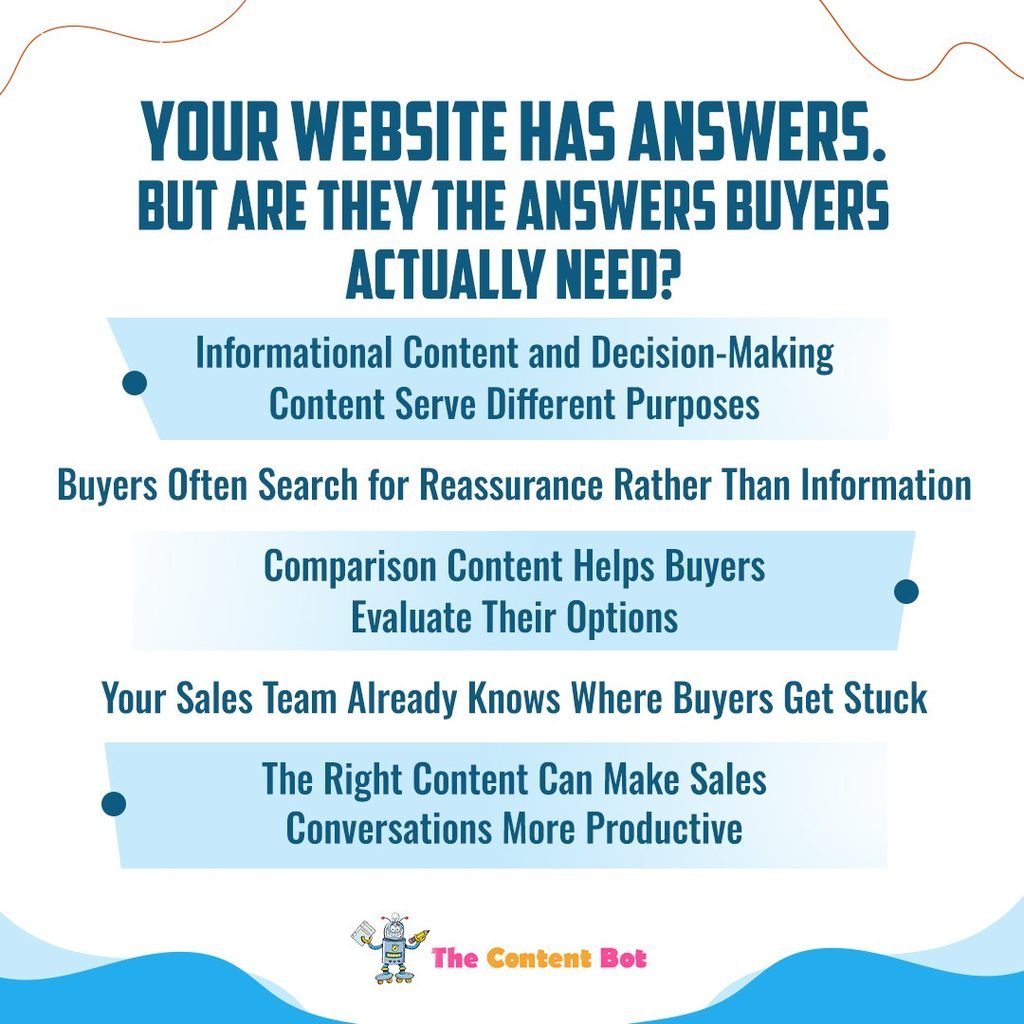
3. Comparison Content Helps Buyers Evaluate Their Options
Businesses sometimes avoid publishing comparisons because they do not want to mention competitors or acknowledge that alternative solutions exist.
However, customers are already making those comparisons.
If someone is evaluating two software platforms, different manufacturing materials, or alternative service models, they will look for information that helps them understand the differences.
When your website does not provide that information, buyers must rely entirely on other sources.
Useful comparison content does not need to criticise competitors or exaggerate the advantages of your own offering. In fact, balanced comparisons can be more credible because they acknowledge that different solutions work better in different circumstances.
A software company might explain when a cloud-based system is preferable to an on-premises solution. An industrial supplier could discuss the advantages and limitations of different materials for particular operating conditions. A consulting firm might compare hiring an internal specialist with working with an external advisory team.
The purpose is to help buyers make informed decisions while demonstrating that your business understands the available options.
Key Insight: Businesses that help customers compare options become more useful during the purchasing process.
4. Your Sales Team Already Knows Where Buyers Get Stuck
One of the most valuable sources of content ideas is often overlooked because it does not appear in a traditional SEO report.
It is the sales team.
Salespeople regularly hear the questions that arise when customers move closer to making a decision. They know which concerns delay proposals, which explanations need to be repeated, and which misunderstandings cause otherwise interested prospects to hesitate.
For example, a prospect may ask whether implementation requires additional technical resources. Another may want to know why a service costs more than a cheaper alternative. Someone else may be concerned about the time commitment required from their own employees.
If these questions appear repeatedly, they should not remain confined to individual sales conversations.
They can become articles, FAQs, comparison guides, case studies, or supporting resources that customers access before speaking with the sales team.
This also creates a more consistent buying experience. Instead of depending entirely on how well an individual salesperson explains something, the business develops reliable content that communicates important information clearly.
Key Insight: Repeated sales objections are often signals that important content is missing from your website.
5. The Right Content Can Make Sales Conversations More Productive
Content marketing is frequently measured by how many visitors or leads it generates. However, one of its less visible benefits is improving the quality of conversations that happen after a prospect makes contact.
Consider a buyer who has already reviewed your implementation process, understood the pricing factors, compared alternatives, and read a relevant case study.
That buyer enters the conversation with a much clearer understanding of your offering.
Instead of spending most of the meeting explaining basic information, your sales team can focus on the customer’s specific requirements, potential challenges, and next steps.
This does not mean content eliminates the need for salespeople. Complex B2B decisions often require personal discussions, technical clarification, negotiation, and internal stakeholder alignment.
Good content supports those conversations by helping buyers prepare for them.
It can also help prospects share accurate information with colleagues who are involved in the decision but may never speak directly with your sales team.
Key Insight: Effective content does not replace sales conversations. It makes those conversations more valuable.
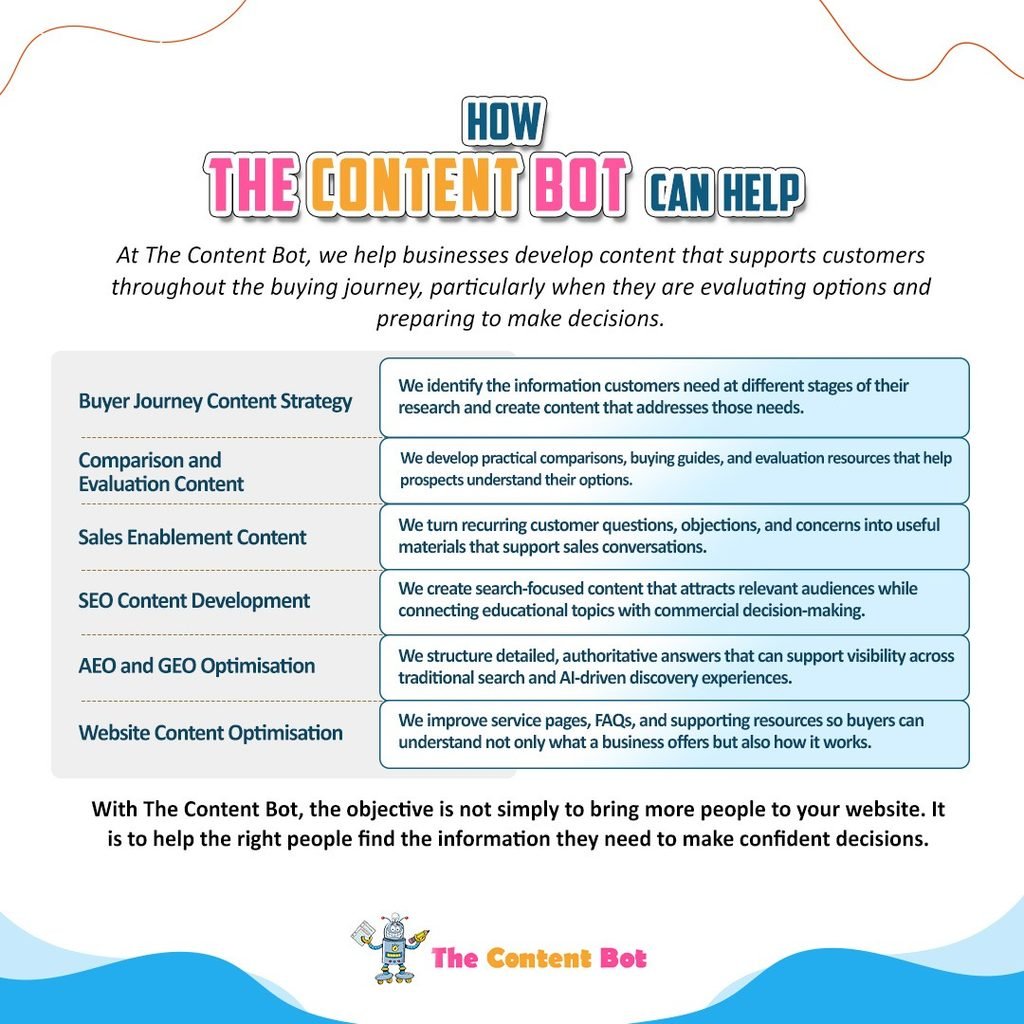
How The Content Bot Can Help
At The Content Bot, we help businesses develop content that supports customers throughout the buying journey, particularly when they are evaluating options and preparing to make decisions.
Buyer Journey Content Strategy
We identify the information customers need at different stages of their research and create content that addresses those needs.
Comparison and Evaluation Content
We develop practical comparisons, buying guides, and evaluation resources that help prospects understand their options.
Sales Enablement Content
We turn recurring customer questions, objections, and concerns into useful materials that support sales conversations.
SEO Content Development
We create search-focused content that attracts relevant audiences while connecting educational topics with commercial decision-making.
AEO and GEO Optimisation
We structure detailed, authoritative answers that can support visibility across traditional search and AI-driven discovery experiences.
Website Content Optimisation
We improve service pages, FAQs, and supporting resources so buyers can understand not only what a business offers but also how it works.
With The Content Bot, the objective is not simply to bring more people to your website. It is to help the right people find the information they need to make confident decisions.
Frequently Asked Questions
What is decision-making content? Decision-making content helps potential customers evaluate solutions, compare alternatives, understand purchasing considerations, and address concerns before committing to a product or service.
How is decision-making content different from educational content? Educational content explains concepts and problems, while decision-making content helps buyers assess whether a particular solution is suitable for their requirements.
Should businesses publish competitor comparison articles? They can, provided the comparisons are accurate, fair, and genuinely useful. Comparisons should explain meaningful differences rather than simply promote one provider.
Can FAQs improve conversions? Well-written FAQs can address uncertainty and help buyers understand important details. Their impact depends on the relevance of the questions and the overall website experience.
How can businesses identify missing decision-making content? Review sales conversations, customer objections, support enquiries, website search data, and questions prospects repeatedly ask before purchasing.
Does decision-making content help with AI search? Detailed, clearly structured information can help search systems understand and retrieve relevant answers. However, publishing this type of content does not guarantee inclusion in AI-generated responses.
Here’s How This Helps
SaaS Company Explains Implementation Requirements
A SaaS provider discovers that prospects frequently hesitate because they are unsure how difficult implementation will be. The company creates a detailed onboarding guide covering timelines, integrations, employee training, and responsibilities. Buyers can now evaluate the practical requirements before requesting a demonstration.
Industrial Supplier Simplifies Product Selection
An industrial supplier notices that procurement teams regularly request clarification about material specifications and application suitability. By publishing selection guides and technical comparisons, the supplier helps customers narrow down appropriate products before submitting enquiries.
Consulting Firm Addresses Pricing Concerns
A consulting business receives frequent questions about why project costs vary. Instead of leaving every explanation to the sales team, it publishes a guide describing the factors that influence pricing, project scope, and delivery requirements.
B2B Service Provider Supports Internal Approvals
A service provider learns that interested prospects often struggle to explain the proposed solution to their management teams. It develops clear process documentation, implementation summaries, and business-case resources that buyers can share internally.
Most businesses have no shortage of information on their websites. The real question is whether that information helps customers make progress towards a decision.
Buyers need different kinds of support throughout their research. Early on, they may want to understand a problem. Later, they need to compare solutions, evaluate practical requirements, and feel confident that their decision is appropriate.
Businesses that recognise these changing needs can create content that serves a much more meaningful purpose than simply attracting traffic.
At The Content Bot, we help companies connect their content strategies with the questions, concerns, and decisions that shape real purchasing journeys.
Because answering a customer’s question is useful. Helping them make the right decision is where content becomes genuinely valuable.
