
Customer Questions Your Website Never Answers – Open most business websites and you’ll find the usual pages.
Home. About. Services. Products. Contact.
Everything the company wants to say is there.
But there’s often something missing: the things customers actually want to know.
How much does this cost? Which option is right for me? How does this compare with an alternative? How long will implementation take? What could go wrong? Is this suitable for a company like mine?
These questions are being searched every day.
And when your website doesn’t answer them, someone else’s probably does.
This creates a strange situation. A business can have a professional website, publish blogs regularly, and invest heavily in SEO while remaining absent from some of the most valuable conversations happening in its market.
The problem isn’t always that you need more content.
Sometimes you need to answer better questions.
1. Businesses Write From the Inside Out
One reason this happens is simple.
Companies know too much about themselves.
Teams spend every day discussing products, capabilities, features, processes, and internal terminology. Naturally, that language finds its way onto the website.
Customers approach the same business from a completely different perspective.
They don’t necessarily know the terminology.
They know their problem.
A software company might talk about “workflow orchestration.”
Its customer might search:
“How do I stop my team doing the same task manually every week?”
Both may be talking about exactly the same problem.
But if your content only speaks the language of the company, you can miss the language of the buyer.
Key Insight: Your customers search in problems before they learn to search in solutions.
2. The Best Questions Often Come From Sales
SEO tools are useful.
But some of your best content ideas may already be sitting inside your sales team’s conversations.
Think about the questions prospects repeatedly ask during meetings.
“How long does this take?”
“Why are you more expensive?”
“Can this integrate with our existing system?”
“What’s the difference between these two options?”
“Will this work for a company our size?”
If prospects repeatedly ask these questions after contacting you, there is a good chance other buyers are researching similar concerns before making contact.
Those questions deserve content.
A strong content strategy doesn’t only look at keyword databases.
It listens to sales calls, customer support conversations, objections, emails, and actual buying behaviour.
Key Insight: Your sales conversations are one of your most valuable sources of content research.
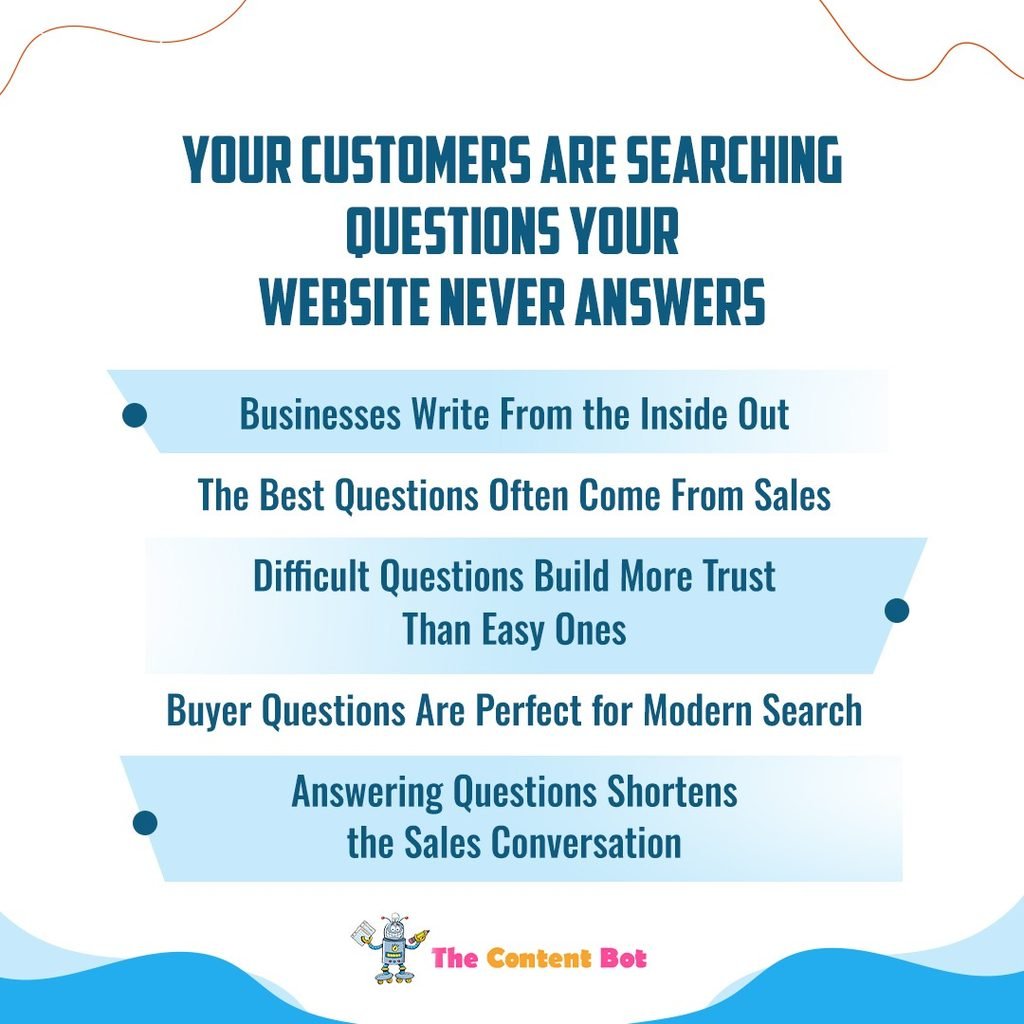
3. Difficult Questions Build More Trust Than Easy Ones
Businesses naturally prefer writing content that makes them look good.
That’s understandable.
But buyers often care about uncomfortable questions.
What are the limitations?
When is your solution not the right choice?
What does implementation actually involve?
Why does it cost more than an alternative?
What mistakes do customers make?
These topics can feel risky because they expose complexity.
In reality, they can build enormous trust.
Buyers already know that no solution is perfect. When a business openly discusses limitations, trade-offs, and realistic expectations, it feels more credible.
Pretending every product is perfect doesn’t create confidence.
Transparency does.
Key Insight: Answering uncomfortable questions can make your business more trustworthy, not less.
4. Buyer Questions Are Perfect for Modern Search
Question-led content isn’t only useful for humans.
It fits naturally with the direction search is moving.
People increasingly use conversational searches.
Instead of typing:
“B2B SEO agency”
they might ask:
“Is SEO worth investing in for a B2B company with a six-month sales cycle?”
AI assistants encourage this behaviour even further.
Users can ask detailed questions, provide context, and refine answers through conversation.
This means businesses need content that goes beyond short keywords and addresses complete buyer questions clearly.
FAQ sections, comparison articles, detailed guides, definitions, and problem-solving content can all help search engines and AI systems better understand your expertise.
Key Insight: The more conversational search becomes, the more valuable genuine answers become.
5. Answering Questions Shortens the Sales Conversation
Good content doesn’t replace salespeople.
It makes their conversations better.
Imagine two prospects entering a sales meeting.
The first knows almost nothing about your service.
The salesperson has to explain the basics, answer common questions, clarify pricing expectations, handle obvious objections, and establish credibility.
The second prospect has already read your guides, comparison pages, FAQs, and case studies.
They understand your approach.
Their questions are more specific.
The conversation can move much faster toward fit, implementation, and decision-making.
That’s what good content should do.
It doesn’t simply generate traffic.
It prepares buyers.
Key Insight: Educated prospects can spend sales conversations making decisions instead of gathering basic information.
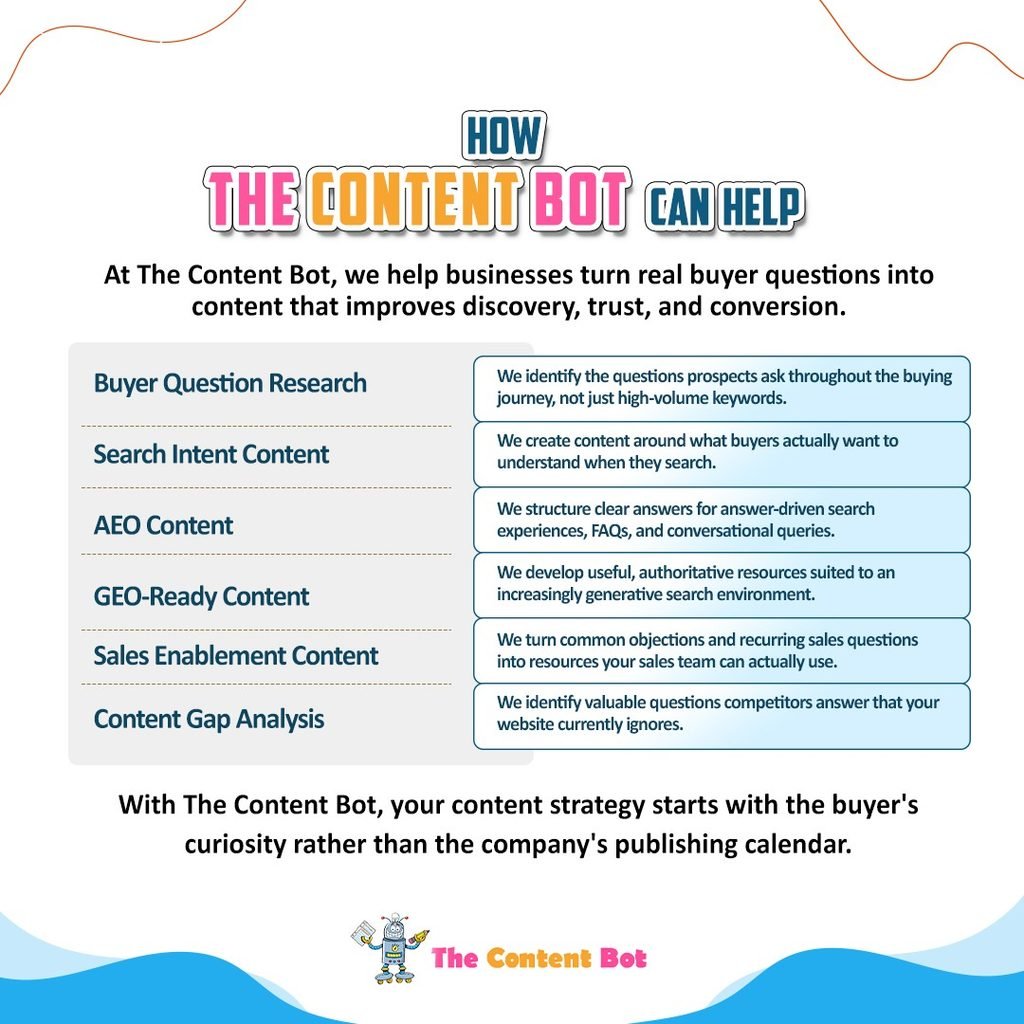
How The Content Bot Can Help
At The Content Bot, we help businesses turn real buyer questions into content that improves discovery, trust, and conversion.
Buyer Question Research
We identify the questions prospects ask throughout the buying journey, not just high-volume keywords.
Search Intent Content
We create content around what buyers actually want to understand when they search.
AEO Content
We structure clear answers for answer-driven search experiences, FAQs, and conversational queries.
GEO-Ready Content
We develop useful, authoritative resources suited to an increasingly generative search environment.
Sales Enablement Content
We turn common objections and recurring sales questions into resources your sales team can actually use.
Content Gap Analysis
We identify valuable questions competitors answer that your website currently ignores.
With The Content Bot, your content strategy starts with the buyer’s curiosity rather than the company’s publishing calendar.
Frequently Asked Questions
How do I find questions my customers are searching? Start with Search Console data, sales conversations, customer emails, support tickets, keyword research, People Also Ask results, forums, and conversations within your industry.
Should every customer question become a separate blog? No. Related questions can often be grouped into one comprehensive article, FAQ, guide, or service page.
Are low-search-volume questions worth answering? They can be, particularly when the question shows strong buying intent or addresses an important sales objection.
Should businesses discuss pricing in their content? When appropriate, yes. Even when exact pricing cannot be published, explaining pricing factors and ranges can help buyers understand what to expect.
Does FAQ content help with AI search? Clear question-and-answer content can make information easier to interpret, although no format guarantees inclusion in an AI-generated answer.
Can this type of content improve sales? Yes. Useful content can educate prospects, address objections, build trust, and help buyers arrive at sales conversations better informed.
Here’s How This Helps
SaaS Company Turns Objections Into Content
A SaaS team notices prospects repeatedly asking about implementation time and integrations. It creates detailed resources answering both questions, giving future buyers useful information before they request a demo.
Manufacturer Explains What Buyers Actually Need
A manufacturer stops publishing only product announcements and begins answering technical selection questions customers regularly ask its sales engineers. Its content becomes considerably more useful during purchasing research.
Consulting Firm Addresses Pricing Early
A consultancy creates an article explaining what affects project costs rather than hiding the subject completely. Prospects enter conversations with more realistic expectations.
B2B Provider Creates Comparison Content
A service provider notices that buyers frequently compare its approach with a common alternative. Instead of avoiding the comparison, it publishes a balanced guide explaining where each option makes sense.
Businesses don’t usually suffer from a shortage of things to talk about.
They suffer from a gap between what they want to say and what buyers actually want to know.
That gap matters more as search becomes conversational and buyers conduct more research independently.
The companies that answer useful, specific, and sometimes uncomfortable questions have an opportunity to become valuable resources before a sales conversation ever begins.
At The Content Bot, we help businesses uncover those questions and turn them into content built around real buyer intent.
Because your next great blog topic may not be sitting inside a keyword tool.
It may be the question your sales team answered three times this morning.
